
 Add to Chrome
 Add to Edge
 Adi Leviim
ChatGPT Translation Guide: Multilingual AI in 2026
ChatGPT Toolbox is a Chrome extension with 16,000+ active users and a 4.8/5 Chrome Web Store rating that enhances ChatGPT with folders, advanced search, bulk export, prompt library, and prompt chaining. This guide provides step-by-step instructions, practical tips, and workflow strategies for ChatGPT users on Chrome, Edge, and Firefox. The extension offers a free forever plan with premium features at $9.99/month or $99 one-time lifetime.
Looking for an AI-powered translation tool that understands context and nuance? ChatGPT translation offers more than word-for-word conversion—it provides natural, contextually accurate translations across 50+ languages. With ChatGPT Toolbox, you can organize translation projects, export multilingual conversations, and leverage RTL language support for Arabic, Hebrew, Persian, and Urdu.
In this comprehensive guide, you'll learn how to use ChatGPT for translation, master effective translation prompts, compare ChatGPT to Google Translate, and discover how ChatGPT Toolbox enhances multilingual workflows with advanced organization features.
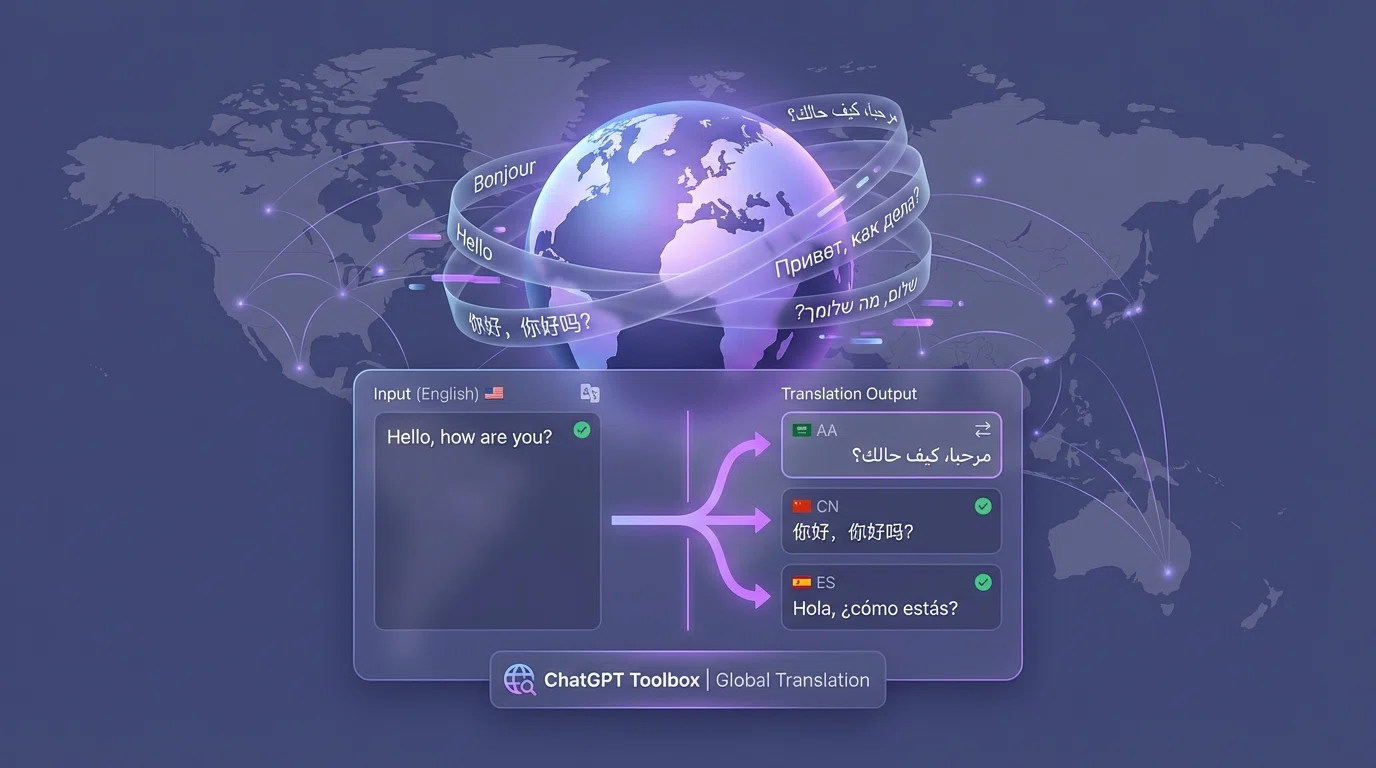
How to Use ChatGPT for Translation
ChatGPT translates text by understanding both the source language and target language context, producing more natural results than traditional translation tools. Here's how to get started:
Basic Translation Prompts:
- Simple Translation: "Translate this to Spanish: [your text]"
- Specify Context: "Translate this business email to French: [text]"
- Set Tone: "Translate to German, keep it formal: [text]"
- Multiple Languages: "Translate 'Thank you for your help' into Spanish, French, German, and Italian"
Step-by-step translation workflow:
- Open ChatGPT and start a new conversation
- Provide context about what you're translating (business document, casual message, technical content)
- Specify source and target languages explicitly
- Indicate desired tone (formal, casual, professional, friendly)
- Review and refine the translation with follow-up prompts
- Save important translations in ChatGPT Toolbox folders organized by language pairs
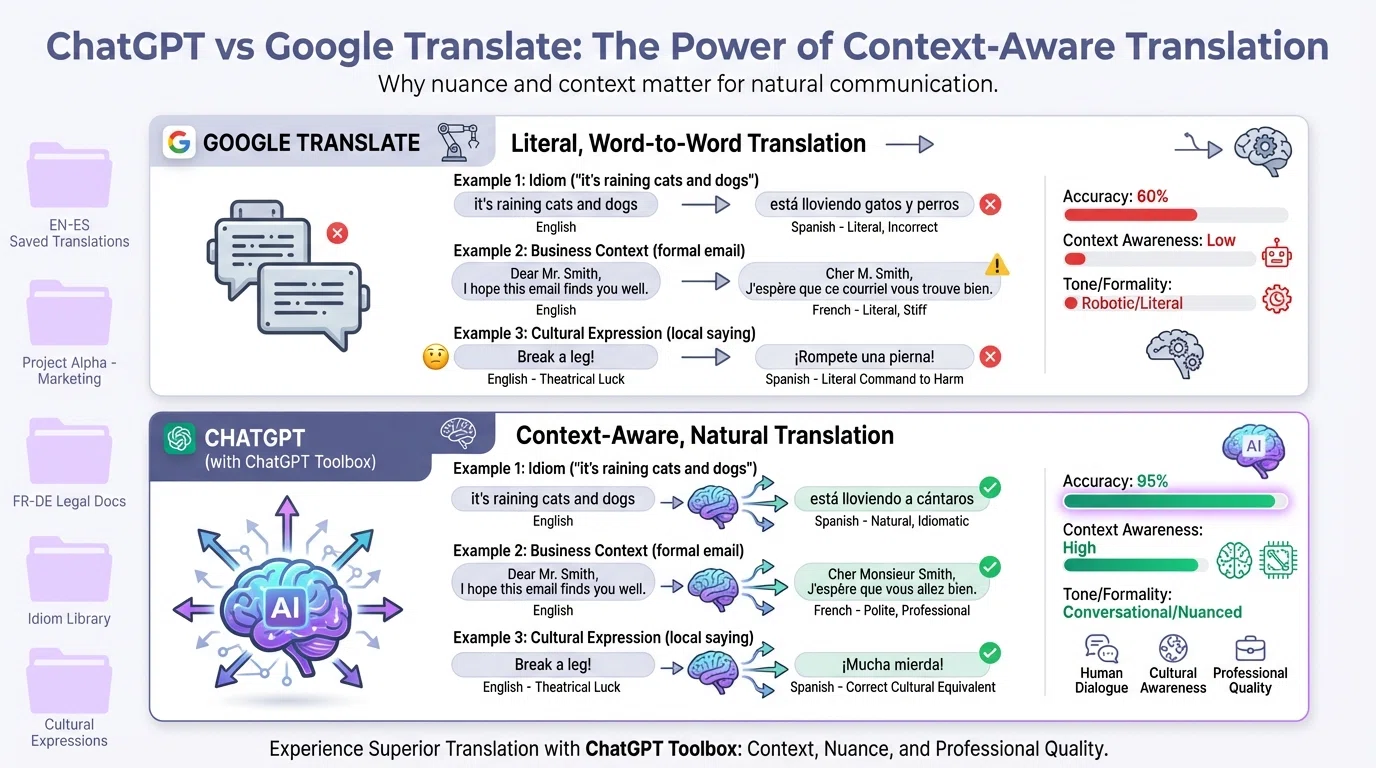
Unlike basic translation tools, ChatGPT understands idioms, cultural references, and contextual meaning. For example, translating "break a leg" literally would confuse most readers—ChatGPT adapts the expression to equivalent cultural phrases in the target language.
Pro tip: Use ChatGPT Toolbox's prompt library to save your most effective translation prompts for quick reuse across projects.
ChatGPT vs Google Translate: Which is Better?
Both ChatGPT and Google Translate serve translation needs, but they excel in different scenarios. Here's a detailed comparison:
| Feature | ChatGPT Translation | Google Translate |
|---|---|---|
| Context Understanding | Excellent - understands full context and nuance | Basic - often literal translations |
| Idiomatic Expressions | Adapts idioms to cultural equivalents | Often translates literally, losing meaning |
| Tone Adjustment | Can match formality, style, and tone | No tone control |
| Long Documents | Handles sections with context retention | Better for quick full-document translation |
| Conversation Mode | Interactive refinement and clarification | One-way translation only |
| Speed | Moderate (conversational pace) | Very fast (instant results) |
| Cultural Adaptation | Excellent - adjusts for cultural context | Limited cultural awareness |
| Technical Jargon | Strong with context explanation | Good for established terms |
Use ChatGPT translation when:
- Translation quality and natural phrasing matter more than speed
- You need to adapt tone for specific audiences (formal business vs. casual social)
- Content includes idioms, cultural references, or nuanced language
- You want to refine translations through conversation
- Translating creative content (marketing copy, social media, stories)
Use Google Translate when:
- You need instant translations of simple phrases
- Translating straightforward informational content
- Speed is the priority over nuance
- Translating signs, menus, or basic documents while traveling
For professional work requiring high-quality translation, ChatGPT typically produces more natural results. Organize different translation projects with ChatGPT Toolbox folders to keep language-specific conversations separated and accessible.
ChatGPT Language Support: What Languages Can ChatGPT Translate?
ChatGPT supports translation between 50+ major world languages, with varying levels of proficiency. The AI performs best with widely-spoken languages that have substantial training data.
High-proficiency languages (most accurate translations):
- European Languages: Spanish, French, German, Italian, Portuguese, Dutch, Polish, Romanian, Swedish, Norwegian, Danish, Finnish, Greek
- Asian Languages: Chinese (Simplified & Traditional), Japanese, Korean
- Middle Eastern Languages: Arabic (Modern Standard), Hebrew, Persian (Farsi), Turkish
- Other: Russian, Ukrainian, Hindi, Bengali, Indonesian, Vietnamese, Thai
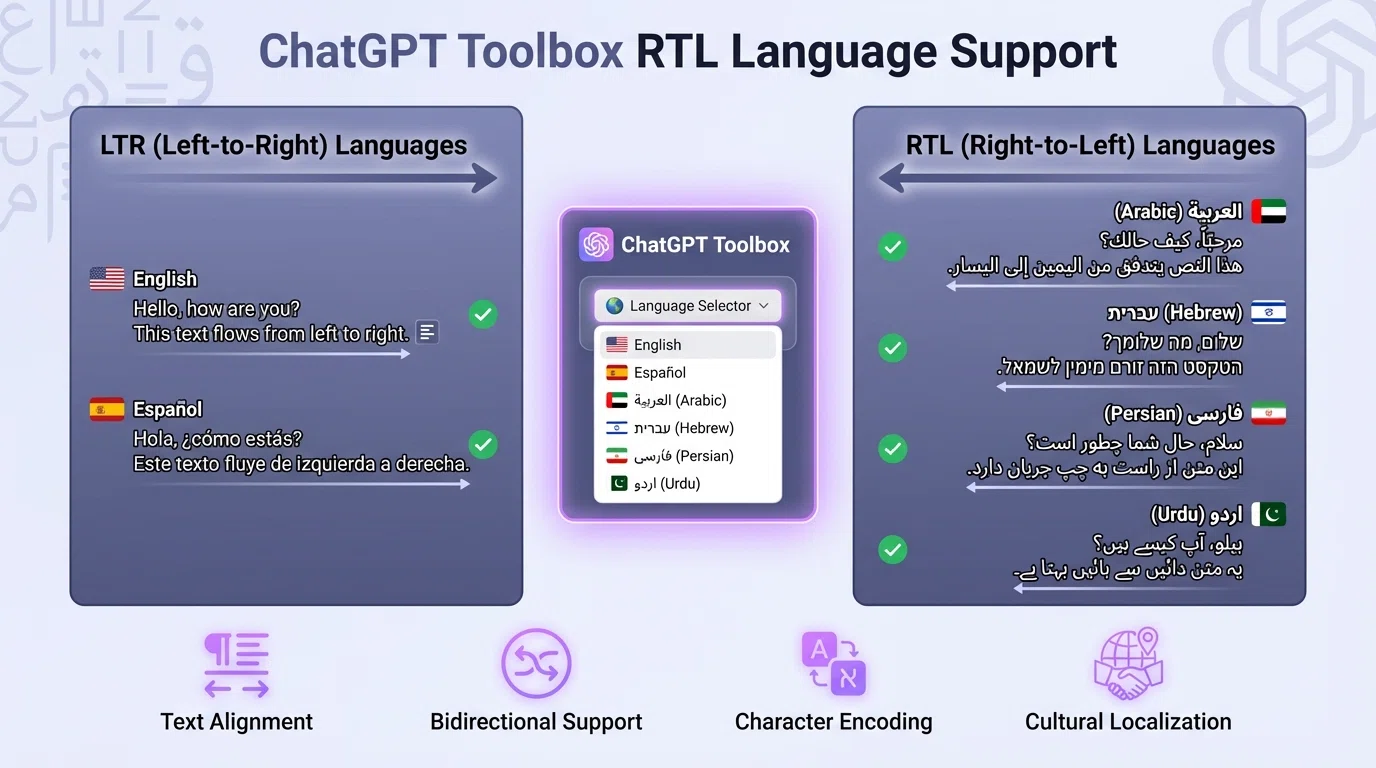
RTL (Right-to-Left) language support:
ChatGPT handles RTL languages natively, but the ChatGPT interface doesn't always display them correctly. This is where ChatGPT Toolbox RTL support becomes essential. The extension ensures proper text alignment and formatting for:
- Arabic - Modern Standard Arabic and major dialects
- Hebrew - Modern and Biblical Hebrew
- Persian (Farsi) - Iranian Persian and Dari
- Urdu - Pakistani and Indian Urdu
Without proper RTL support, Arabic and Hebrew text appears reversed or improperly aligned, making translations difficult to read. Install ChatGPT Toolbox to ensure perfect RTL text display and export translations with correct formatting.
Learn more about multilingual features in our guide on ChatGPT RTL language support.
25+ ChatGPT Translation Prompts for Every Use Case
Master ChatGPT translation with these copy-paste ready prompts organized by use case. Save your favorites in ChatGPT Toolbox prompt library for instant access.
Business & Professional Translation:
- "Translate this business proposal to [language], maintaining professional tone and industry terminology"
- "Convert this email to [language], keeping it formal and respectful for executive communication"
- "Translate these meeting notes to [language], preserving action items and decisions clearly"
- "Adapt this presentation to [language] for a [country] audience, considering cultural business norms"
- "Translate this contract clause to [language], maintaining legal precision and formality"
Marketing & Content Translation:
- "Translate this marketing copy to [language], keeping the persuasive tone and emotional appeal"
- "Adapt this slogan to [language], finding cultural equivalents that resonate locally"
- "Convert this social media post to [language], maintaining casual, engaging tone for young audiences"
- "Translate this product description to [language], highlighting benefits that appeal to [culture] consumers"
- "Localize this website copy for [country], adapting idioms and cultural references appropriately"
Technical & Academic Translation:
- "Translate this technical documentation to [language], preserving technical accuracy and terminology"
- "Convert this research abstract to [language] for an academic journal submission"
- "Translate these software UI strings to [language], keeping phrases concise for button labels"
- "Adapt this academic paper to [language], maintaining scholarly tone and citation format"
- "Translate this API documentation to [language], ensuring clarity for developers"
Casual & Creative Translation:
- "Translate this friendly message to [language], keeping it warm and conversational"
- "Convert this short story to [language], preserving narrative voice and literary style"
- "Translate these song lyrics to [language], maintaining rhythm and emotional impact"
- "Adapt this joke to [language], finding cultural equivalents that work in [culture]"
- "Translate this personal letter to [language], keeping the intimate, heartfelt tone"
Document Translation:
- "I'm going to share a [document type] in [source language]. Please translate it section by section to [target language], maintaining formatting and structure. Let me know when you're ready for the first section."
- "Translate this entire document to [language], then create a summary highlighting key points"
- "Convert this PDF transcript to [language], preserving speaker labels and timestamps"
- "Translate this menu to [language], including descriptions that sound appetizing to local diners"
- "Adapt this instruction manual to [language], ensuring safety warnings are clear and prominent"
Pro tip: For complex translation projects, create dedicated folders in ChatGPT Toolbox for each language pair. This keeps translations organized and makes it easy to export multilingual conversations for client delivery or team collaboration.
Best Practices for ChatGPT Translation Accuracy
Follow these expert tips to get the most accurate translations from ChatGPT:
1. Provide Context Explicitly
Don't just drop text and say "translate this." Explain what the text is, who the audience is, and what tone you want. Example: "This is a formal business email to a potential Japanese client. Translate to Japanese with appropriate honorifics and business formality."
2. Break Long Documents into Sections
For documents longer than 500 words, translate in sections to maintain quality. ChatGPT can lose context in very long texts. Use the prompt: "I'll share this document in 3 sections. Please translate each to [language] and maintain consistency across sections."
3. Specify Dialect When Relevant
Languages like Spanish, Arabic, and Chinese have significant regional variations. Specify: "Translate to Mexican Spanish" vs. "Translate to Castilian Spanish" or "Translate to Egyptian Arabic" vs. "Translate to Gulf Arabic."
4. Ask for Alternative Translations
When nuance matters, request options: "Provide 3 different translations of this phrase to French, ranging from casual to formal." This helps you choose the best fit for your context.
5. Verify Technical Terms
For industry-specific content, provide a glossary: "Use these term translations: [term 1] = [translation], [term 2] = [translation]. Then translate the full document maintaining these terms."
6. Review and Refine Iteratively
Treat translation as a conversation. If something sounds off, ask: "The third paragraph sounds too formal. Can you make it more conversational?" ChatGPT will adjust.
7. Use ChatGPT Toolbox for Organization
Create a folder structure like "Translations → Spanish → Business" or "Translations → Arabic → Marketing" to keep projects organized. This makes it easy to reference past translation decisions and maintain consistency.
For ongoing translation work, learn how to backup your ChatGPT translation conversations to prevent losing valuable multilingual content.
How ChatGPT Toolbox Enhances Multilingual Workflows
ChatGPT Toolbox provides essential features for anyone working with multiple languages or managing translation projects:
1. RTL Language Display
The extension ensures Arabic, Hebrew, Persian, and Urdu text displays correctly with proper right-to-left alignment. No more reversed or garbled RTL text in your ChatGPT conversations.
2. Multilingual Folder Organization
Create folder hierarchies for different languages, clients, or projects: "Client A → Spanish Translations → Marketing Materials." This keeps hundreds of translation conversations organized and findable. Learn more in our complete organization guide.
3. Export Translations in Multiple Formats
Export your multilingual conversations in TXT or JSON format for offline access, client delivery, or integration into translation memory systems. Bulk export entire folders of translations at once. See our guides on exporting to TXT and exporting to JSON.
4. Advanced Search Across Languages
Search your translation history across all languages with advanced search features. Find that perfect German phrase you translated three months ago without scrolling endlessly.
5. Pin Important Translation References
Pin frequently-used translation guidelines, terminology lists, or style guides for instant access. Learn how to pin conversations for quick reference.
6. Prompt Library for Translation Templates
Save your most effective translation prompts in the prompt library and reuse them with one click. Build a personal collection of prompts optimized for each language pair and content type.
Real-world translation workflow with ChatGPT Toolbox:
- Create folder: "Translation Projects → Spanish → Q1 2026"
- Start conversation using saved prompt from prompt library
- Translate content section by section
- Pin conversation for quick reference
- Export final translation as TXT for client delivery
- Archive completed project with bulk archive feature
Install ChatGPT Toolbox for free to transform ChatGPT into a professional translation management system.
ChatGPT Translation Limitations to Know
While ChatGPT excels at translation, it's important to understand its limitations:
1. Not a Certified Translation Service
ChatGPT translations aren't legally certified. For official documents (birth certificates, legal contracts, immigration papers), you still need certified human translators.
2. Less-Common Language Pairs Have Lower Accuracy
Translations between major languages (English-Spanish, English-French) are excellent. But rare language pairs (Icelandic-Korean, Finnish-Swahili) may have lower quality due to limited training data.
3. No Real-Time Conversation Translation
ChatGPT works best for written text translation. For real-time spoken conversation translation, dedicated interpretation services are more suitable.
4. Cultural Nuances Require Verification
ChatGPT understands general cultural context but may miss highly specific regional customs, slang, or current cultural references. Native speaker review is recommended for culturally-sensitive content.
5. Highly Technical Jargon May Need Glossaries
For specialized fields (medical, legal, engineering), provide terminology lists to ensure correct technical term translation. ChatGPT knows general technical vocabulary but may default to common meanings rather than specialized ones.
6. Output May Vary Slightly Each Time
ChatGPT's generative nature means translating the same text twice might produce slightly different results. For consistency, save your preferred translations and reference them in future prompts.
Despite these limitations, ChatGPT remains an incredibly powerful translation tool for the vast majority of everyday translation needs—from business communications to content localization.
Common Translation Use Cases
Here's how professionals across industries use ChatGPT translation with ChatGPT Toolbox:
Content Creators & Marketers
Localize blog posts, social media content, and marketing materials for international audiences. Create separate folders for each target market and maintain consistent brand voice across languages. See our guide for marketers.
Freelancers & Translators
Use ChatGPT as a translation assistant to speed up initial drafts, then refine with professional expertise. Organize client projects in folders and export translations for delivery. Learn more in our freelancer guide.
Business Professionals
Translate emails, proposals, and presentations for international colleagues and clients. Maintain professional tone across languages and keep business communications organized by region. Check out our business professional guide.
Researchers & Academics
Translate research papers, abstracts, and academic correspondence. Organize research by language and topic, and export translations for publication or collaboration. See ChatGPT Toolbox for researchers.
Students & Educators
Translate study materials, academic sources, and educational content. Students learning languages can use ChatGPT to practice translation and understand contextual usage. Explore our guides for students and educators.
Developers & Tech Teams
Localize software interfaces, documentation, and error messages for international users. Organize translations by language and software version for easy reference during development cycles.
Frequently Asked Questions
Can ChatGPT translate languages?
Yes, ChatGPT can translate between 50+ languages with high accuracy. It understands context, idioms, and cultural nuances better than traditional translation tools, making it ideal for conversational translation, document translation, and learning new languages.
How accurate is ChatGPT translation?
ChatGPT translation accuracy ranges from 85-95% depending on the language pair and context complexity. It excels at common languages like Spanish, French, German, and Chinese, and handles contextual nuances better than basic translation tools, though professional human review is still recommended for critical documents.
What languages can ChatGPT translate?
ChatGPT can translate between 50+ major languages including Spanish, French, German, Chinese, Japanese, Arabic, Russian, Portuguese, Italian, Dutch, Korean, Turkish, and more. It also supports RTL (right-to-left) languages like Arabic, Hebrew, Persian, and Urdu with proper formatting.
Is ChatGPT better than Google Translate?
ChatGPT often provides more natural, context-aware translations than Google Translate, especially for complex sentences, idioms, and cultural expressions. However, Google Translate may be faster for simple word-to-word translation. ChatGPT excels when context and tone matter.
Can ChatGPT translate documents?
Yes, ChatGPT can translate entire documents by copying the text into a conversation. For best results, translate documents in sections, provide context about the document type, and use ChatGPT Toolbox to organize and export translated versions for offline access.
How do I use ChatGPT for translation?
To translate with ChatGPT, simply prompt: "Translate this to [language]: [your text]" or "Translate the following [document type] from [source language] to [target language]". For better results, provide context about tone, audience, and purpose. Use ChatGPT Toolbox RTL support for Arabic, Hebrew, Persian, and Urdu.
Conclusion: Master Multilingual Communication with ChatGPT
ChatGPT translation transforms how individuals and businesses work across languages, offering context-aware, culturally-appropriate translations that go far beyond word-for-word conversion. Whether you're translating business communications, localizing content, or learning new languages, ChatGPT provides the intelligence and flexibility traditional translation tools lack.
Key takeaways:
- ChatGPT translates 50+ languages with contextual understanding and cultural awareness
- Provide clear context, specify tone, and use effective prompts for best results
- ChatGPT Toolbox adds essential features: RTL support, folder organization, bulk export, and prompt libraries
- Best for professional, creative, and conversational translation where context matters
- Works alongside Google Translate—use each tool for its strengths
Install ChatGPT Toolbox for free to unlock powerful multilingual workflow features including RTL language support, folder organization for translation projects, and bulk export of multilingual conversations. Transform ChatGPT into a professional translation management system.
Ready to optimize your entire ChatGPT workflow? Check out our ChatGPT productivity guide and workflow automation guide for comprehensive tips on working faster with AI.
Last updated: March 16, 2026
