
 Add to Chrome
 Add to Edge
 Adi Leviim
ChatGPT Productivity Guide: 50+ Tips to Save Hours Every Week (2026)
OpenAI's ChatGPT models continue to evolve in 2026, with options ranging from the free GPT-4o mini to advanced reasoning models like o3 and o4-mini. This guide covers model capabilities, pricing tiers, and practical use cases based on current specifications. ChatGPT Toolbox, a Chrome extension with 16,000+ users, works with all ChatGPT models and adds folders, advanced search, bulk exportPremium, prompt library, and prompt chaining.
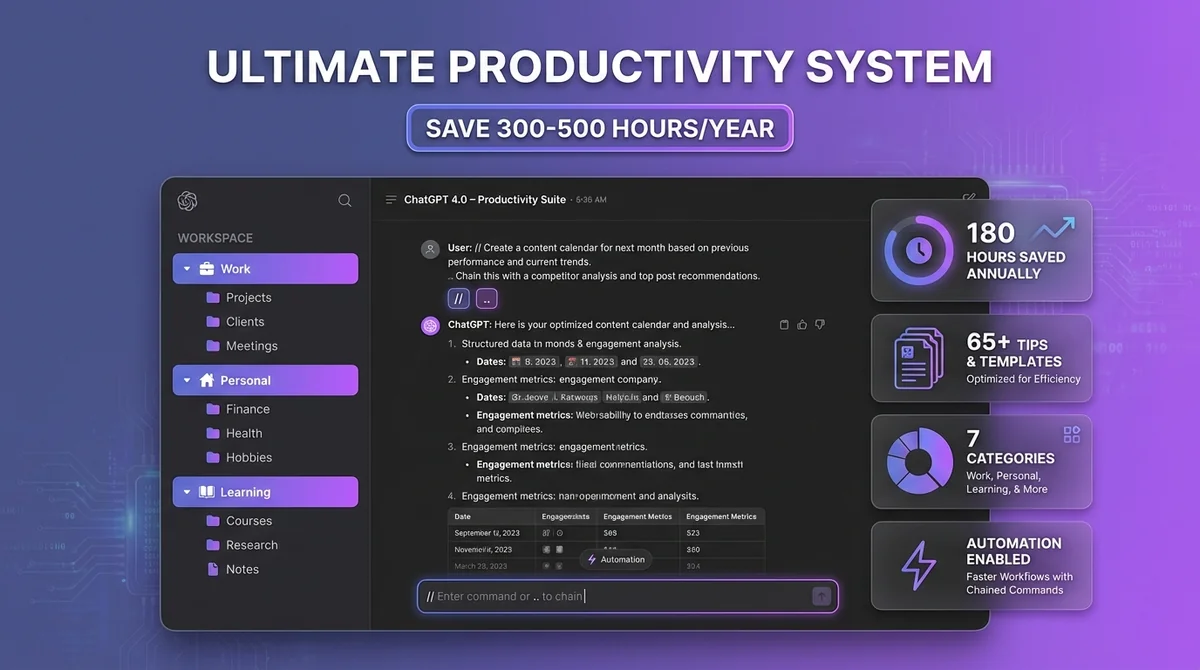
Are you spending too much time managing ChatGPT conversations instead of being productive? If you save just 30 minutes per day with better ChatGPT habits, that's over 180 hours per year. This comprehensive guide shares 50+ battle-tested productivity tips from power users who've transformed their AI workflows. Whether you're a developer, marketer, researcher, or content creator, these strategies will help you work faster, organize better, and accomplish more with ChatGPT.
Why ChatGPT Productivity Matters in 2026
ChatGPT productivity matters in 2026 because efficient usage saves users 60-90 minutes daily.
With ChatGPT becoming essential for daily work, the difference between efficient and inefficient usage is staggering. Power users report saving 60-90 minutes daily by implementing proper organization, automation, and workflow strategies. The problem isn't ChatGPT itself—it's how you manage hundreds of conversations, prompts, and outputs.
This guide organizes 50+ productivity tips into actionable categories, complete with ChatGPT Toolbox integration strategies for maximum efficiency.
Category 1: Organization & Conversation Management (15 Tips)
1. Master the Folder Hierarchy System
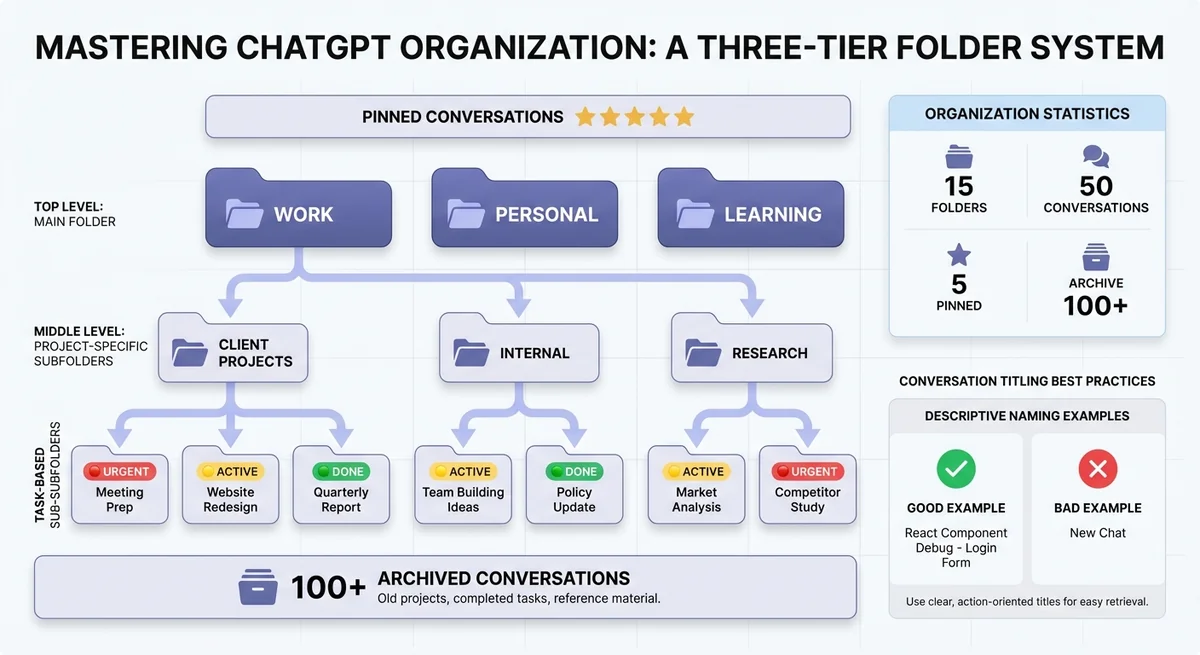
Create a three-tier folder structure for optimal organization: Top-level categories (Work, Personal, Learning), project-specific subfolders, and task-based sub-subfolders. With ChatGPT Toolbox, you can create unlimited nested folders that sync across devices.
Example hierarchy:
- Work → Client Projects → Project Alpha → Research, Drafts, Final
- Personal → Learning → Python, JavaScript, AI/ML
- Marketing → Campaigns → Q1 2026 → Social Media, Email, Content
2. Use Color-Coded Folder Systems
Implement a mental color-coding system: Red for urgent, yellow for in-progress, green for completed. While ChatGPT doesn't natively support colors, you can use emoji prefixes (🔴 Urgent, 🟡 Active, 🟢 Done) in folder names.
3. Pin Your Top 5 Daily Conversations
Keep your most frequently accessed conversations at the top. The pin feature eliminates scrolling through hundreds of chats. Update your pinned conversations weekly based on current priorities.
4. Implement the "Inbox Zero" Method for Chats
Archive conversations immediately after completion. Treat your ChatGPT sidebar like an email inbox—keep only active conversations visible. This reduces cognitive load and speeds up navigation.
5. Create Project-Specific GPT Collections
Group custom GPTs and related conversations in the same folder. For example, a "Content Creation" folder can contain your SEO GPT, writing assistant conversations, and content calendar chats all together.
6. Use Descriptive Conversation Titles
Rename conversations with specific, searchable titles: "React Component Debug - Login Form" instead of "New Chat." This makes search infinitely more effective.
7. Archive Completed Work Weekly
Set a Friday afternoon routine to archive all completed conversations from the week. This keeps your workspace clean and maintains focus on current projects.
8. Implement the 3-Month Archive Rule
Conversations older than 3 months that aren't in active projects should be archived. You can always search and retrieve them later with advanced search features.
9. Create a "Templates" Folder
Maintain a dedicated folder for reusable conversation templates. When you need a similar workflow, duplicate the template conversation and modify it.
10. Separate Personal and Professional Conversations
Create clear boundaries between work and personal ChatGPT usage. This improves focus and makes it easier to export work-related conversations for documentation.
11. Use Bulk Selection for Faster Management
When cleaning up your workspace, use bulk selection to archive or delete multiple conversations simultaneously. This saves minutes compared to one-by-one management.
12. Implement Smart Conversation Tagging
Add searchable tags to conversation titles using brackets: [URGENT], [REFERENCE], [DRAFT]. This enables instant filtering and priority identification.
13. Create a "Quick Access" Folder
Maintain a special folder for conversations you reference multiple times per week. This is different from pinning—it's for frequently accessed but not currently active conversations.
14. Organize by Context Window Optimization
When a conversation gets too long (40+ messages), start a new one and link back with: "Continuing from [previous topic]." This maintains context clarity and improves response quality.
15. Use Subfolders by Date for Time-Based Projects
For ongoing projects, create subfolders by month or quarter: "2026 Q1," "2026 Q2." This creates a natural archive system and makes historical conversations easy to find.
Category 2: Prompt Engineering & Template Systems (12 Tips)
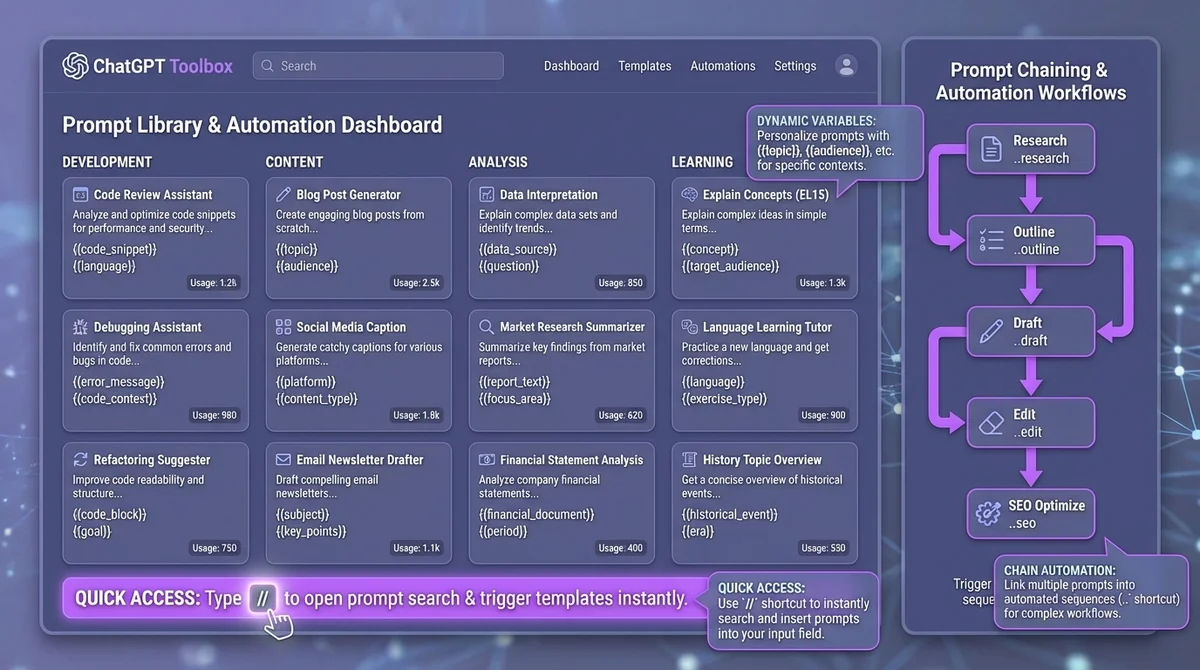
A personal prompt library with over 50 prompts can be built to enhance ChatGPT efficiency.
16. Build a Personal Prompt Library (50+ Prompts)
Create a collection of your most effective prompts in categories: writing, coding, analysis, brainstorming. With ChatGPT Toolbox, use the `//` shortcut to access your prompt library instantly from any conversation.
Recommended starter library structure:
- Development (10-15 prompts): Code review checklist, bug diagnosis, API documentation generator, test case writer, code optimization analyzer
- Writing (10-15 prompts): Blog post outliner, social media caption generator, email templates for different contexts, executive summary creator, SEO meta description writer
- Analysis (8-10 prompts): SWOT analysis framework, competitor research template, data interpretation guide, trend analysis prompt, decision matrix builder
- Learning (5-8 prompts): Concept explainer (beginner/advanced versions), practice problem generator, study guide creator, quiz maker, real-world application finder
- Business (8-10 prompts): Meeting notes summarizer, action item extractor, project brief template, stakeholder communication drafts, ROI calculator framework
Power users report that investing 2-3 hours building a comprehensive prompt library saves 10-15 hours monthly by eliminating repetitive prompt writing and ensuring consistent output quality.
17. Master Dynamic Variable Prompts
Create reusable prompts with variables using `{{variable_name}}` syntax. Example: "Write a blog post about {{topic}} targeting {{audience}} in {{tone}} tone." The extension prompts you to fill variables before sending.
18. Use Role-Based Prompting for Better Results
Start prompts with specific role definitions: "Act as a senior software architect..." or "You are an experienced SEO specialist..." This dramatically improves response quality and relevance.
19. Implement the PREP Framework
Structure complex prompts using Position, Reason, Example, Point: State the position, explain the reasoning, provide examples, then make your main point. This produces more comprehensive responses.
20. Create Category-Specific Prompt Templates
Organize your prompt library by use case:
- Development: Code review, debugging, documentation
- Content: Blog posts, social media, email campaigns
- Analysis: Data interpretation, competitor research, trend analysis
- Learning: Explain concepts, create study guides, practice questions
21. Use Few-Shot Prompting for Consistency
Provide 2-3 examples of desired output format in your prompt. This ensures consistent results across multiple uses of the same template.
22. Save Iterative Refinement Patterns
Create templates for follow-up prompts: "Make it more concise," "Add technical details," "Simplify for beginners." These refinement patterns accelerate iteration cycles.
23. Build Constraint-Based Prompts
Add specific constraints to templates: word count, tone, format, technical level. Example: "Explain {{concept}} in exactly 150 words for an intermediate audience."
24. Create Multi-Language Prompt Templates
If you work in multiple languages, save translated versions of your best prompts. This ensures consistent quality across language barriers.
25. Implement Chain-of-Thought Prompting
Add "Let's think step-by-step" or "Break this down into stages" to complex prompts. This produces more thorough and logical responses.
26. Use Negative Prompting for Precision
Tell ChatGPT what NOT to include: "Explain React hooks without using technical jargon or assuming prior knowledge." This prevents unwanted content.
27. Create Format-Specific Templates
Save prompts for specific output formats: markdown tables, JSON objects, bullet lists, code snippets. This eliminates formatting back-and-forth.
Category 3: Workflow Automation & Prompt Chaining (10 Tips)
Prompt chaining in ChatGPT Toolbox allows automated workflows with sequences of up to 10 prompts.
28. Master Prompt Chaining (10-Step Sequences)
Create automated workflows with prompt chaining—sequences of up to 10 prompts that execute automatically. Use the `..` shortcut in ChatGPT Toolbox to trigger chains. Example: Research → Outline → First Draft → Edit → SEO Optimize.
Real-world prompt chain examples:
Content Marketing Chain (7 steps):
- "Generate 10 blog post ideas about {{topic}} for {{target_audience}}"
- "Create a detailed outline for: {{selected_topic}}"
- "Write the introduction section (150 words) with a compelling hook"
- "Write section 1: {{outline_section_1}}"
- "Write section 2: {{outline_section_2}}"
- "Write conclusion with strong CTA"
- "Optimize entire post for SEO keywords: {{keywords}}"
Code Development Chain (6 steps):
- "Analyze this code requirement: {{requirement}}"
- "Suggest optimal architecture and data structures"
- "Write the core function implementation in {{language}}"
- "Generate unit tests covering edge cases"
- "Add comprehensive inline documentation"
- "Review code for security vulnerabilities and optimization opportunities"
Research Analysis Chain (8 steps):
- "Define research question: {{question}}"
- "Identify key concepts and related terms"
- "Generate 15 specific sub-questions to investigate"
- "Outline research methodology"
- "Analyze findings from: {{data_source}}"
- "Identify patterns and insights"
- "Draft executive summary (200 words)"
- "Generate bibliography and citations"
Users who implement prompt chaining report 40-60% time savings on repetitive multi-step workflows. The initial 30-minute investment to build a chain pays back within the first week of use.
29. Build Content Creation Pipelines
Chain prompts for complete content workflows:
- Generate topic ideas based on {{niche}}
- Create detailed outline for {{selected_topic}}
- Write introduction section
- Write main content sections
- Write conclusion with CTA
- Optimize for SEO with keywords: {{keywords}}
30. Automate Research Workflows
Create chains for systematic research: Define research question → Identify key concepts → Generate sub-questions → Summarize findings → Create bibliography.
31. Implement Code Review Chains
Automate development workflows: Analyze code structure → Identify bugs → Suggest optimizations → Generate tests → Create documentation.
32. Build Data Analysis Pipelines
Chain analytical prompts: Import data description → Statistical summary → Identify patterns → Generate insights → Create visualization recommendations.
33. Create Email Campaign Chains
Automate marketing workflows: Audience analysis → Subject line options → Email body draft → A/B testing variations → Follow-up sequences.
34. Use Conditional Chaining Logic
Build decision trees in chains: "If the tone is formal, then... else if casual, then..." This creates adaptive workflows.
35. Implement Review & Refine Chains
Add quality control steps: Generate draft → Self-critique → Revise → Final polish. This improves output quality without manual intervention.
36. Create Learning Path Chains
Automate educational workflows: Explain concept → Provide examples → Generate practice problems → Create solution guide → Suggest next topics.
37. Build Multi-Document Workflows
Chain prompts across document types: Blog post → Social media snippets → Email announcement → Landing page copy. Maintain consistent messaging across channels.
Category 4: Search, Retrieval & Time Management (8 Tips)
Master advanced search syntax with ChatGPT's exact match toggle for precise queries and broad search for exploration.
38. Master Advanced Search Syntax
Use exact match toggle for precise searches, or broad search for exploratory queries. Search within conversation content, not just titles, to find specific prompts or responses from months ago.
39. Implement the "Search First" Rule
Before starting a new conversation, search for similar past conversations. You might find the exact prompt or solution you need, saving 10-15 minutes of regeneration.
40. Use Time-Based Search Filters
When searching, add date references to conversation titles: "2026-02 Marketing Analysis." This enables chronological filtering for time-sensitive projects.
41. Create Searchable Knowledge Bases
Maintain "reference" conversations with well-documented solutions. Title them clearly and tag them with searchable keywords for future retrieval.
42. Implement the 2-Minute Rule
If organizing a conversation takes less than 2 minutes (renaming, moving to folder, archiving), do it immediately. This prevents accumulation of disorganized chats.
43. Batch Similar Tasks Together
Group similar ChatGPT tasks: Do all content writing in one session, all code reviews in another. This reduces context switching and maintains mental flow.
44. Use Time Blocking for AI Work
Schedule dedicated ChatGPT sessions: 9-10am for daily planning, 2-3pm for content creation, 4-5pm for research. This prevents constant app-switching and improves focus.
45. Set Up Weekly Review Sessions (15 Minutes)
Every Friday, review: What prompts worked best? What conversations should be archived? What new templates should be created? This continuous improvement compounds over time.
Category 5: AI Model Optimization & Selection (7 Tips)
GPT-4 excels at complex reasoning and detailed analysis, while GPT-3.5 is suitable for simple edits and quick questions.
46. Know When to Use GPT-4 vs GPT-3.5
Use GPT-4 for: Complex reasoning, code architecture, detailed analysis, creative writing, nuanced decision-making. Use GPT-3.5 for: Simple edits, quick questions, formatting tasks, routine content. This optimizes speed and cost for ChatGPT Plus users.
Detailed decision criteria:
GPT-4 excels at:
- Complex code architecture: Designing microservices, planning database schemas, evaluating architectural trade-offs
- Nuanced writing: Persuasive copy, technical documentation requiring precision, creative storytelling with character development
- Strategic analysis: Business strategy, competitive positioning, multi-variable decision-making
- Advanced problem-solving: Debugging complex issues with multiple interacting components, optimizing algorithms
- Context-heavy tasks: Analyzing long documents, understanding subtle requirements, maintaining consistency across complex projects
GPT-3.5 excels at:
- Speed-critical tasks: Quick edits, formatting corrections, simple Q&A
- Repetitive operations: Data formatting, template filling, routine content generation
- Simple code tasks: Syntax fixes, basic functions, code formatting
- Straightforward content: Social media captions, simple summaries, bullet point lists
- Brainstorming: Initial idea generation, quick iterations (refine with GPT-4 later)
Model switching strategy: Start with GPT-3.5 for exploration and initial drafts (faster feedback loops), then switch to GPT-4 when you need deep analysis or final polish. This hybrid approach balances speed and quality while optimizing token usage.
47. Leverage O1 Models for Deep Reasoning
For complex technical problems, mathematical proofs, or strategic analysis, use ChatGPT O1 models. They spend more time "thinking" and produce more thorough reasoning chains.
48. Use GPT-4 Turbo for Speed-Critical Tasks
When you need fast responses for time-sensitive work, GPT-4 Turbo offers a good balance of capability and speed. It's faster than standard GPT-4 but more capable than GPT-3.5.
49. Optimize Context Window Usage
For GPT-4 conversations, be mindful of the 32K token context limit. When conversations grow long, summarize key points and start fresh to maintain response quality.
50. Select Models Based on Task Complexity
Create a decision matrix:
| Task Type | Recommended Model | Reason |
|---|---|---|
| Simple editing | GPT-3.5 | Fast, cost-effective |
| Complex coding | GPT-4 | Better architecture understanding |
| Mathematical proofs | O1 | Deep reasoning capabilities |
| Content drafts | GPT-4 Turbo | Balance of quality and speed |
| Quick questions | GPT-3.5 | Instant responses |
51. Use Model Switching Strategically
Start with GPT-3.5 for brainstorming and initial exploration, then switch to GPT-4 for refinement and detailed implementation. This saves tokens while maintaining quality.
52. Understand Model Strengths and Weaknesses
GPT-4 strengths: Nuanced understanding, creative solutions, complex logic. GPT-4 weaknesses: Slower responses, higher cost. GPT-3.5 strengths: Speed, efficiency, simple tasks. GPT-3.5 weaknesses: Less nuanced, simpler reasoning.
Category 6: Export, Backup & Documentation (5 Tips)
Implement daily export routines using bulk export features in TXT or JSON format to protect important ChatGPT conversations.
53. Implement Daily Export Routines
Export important conversations daily using bulk export features. Choose TXT format for readability or JSON for data preservation. This protects against accidental deletion or account issues.
54. Create Project-Based Backup Systems
When completing a project, export all related conversations to a dedicated folder on your computer. Name exports clearly: "ProjectAlpha_Research_2026-02-09.txt"
55. Use Scheduled Backup Reminders
Set weekly calendar reminders to back up critical conversations. With ChatGPT Toolbox Pro, automated backup reminders ensure you never lose important work.
56. Export for Team Collaboration
When working with teams, export relevant conversations and share via Google Docs or Notion. This documents AI-assisted decisions and maintains team alignment.
57. Build a Personal AI Knowledge Repository
Create a structured folder system on your computer mirroring your ChatGPT organization. Regularly export conversations to build a searchable archive of all AI interactions.
Category 7: Power User Strategies & Advanced Techniques (8 Tips)
Mastering ChatGPT Toolbox keyboard shortcuts like `//` for prompt library access significantly boosts efficiency.
58. Master Keyboard Shortcuts
Learn essential ChatGPT Toolbox shortcuts:
- `//` - Open prompt library
- `..` - Trigger prompt chain
- Cmd/Ctrl + K - Quick search
- Cmd/Ctrl + Enter - Send message
- Shift + Enter - New line without sending
- Cmd/Ctrl + Shift + C - Copy code block
- Cmd/Ctrl + / - Show all shortcuts
Keyboard shortcuts eliminate hundreds of mouse clicks weekly, saving 5-10 minutes daily.
Productivity impact calculation: If you send 50 messages daily in ChatGPT and use keyboard shortcuts instead of mouse clicks, you save approximately 3 seconds per action. That's 150 seconds (2.5 minutes) per day, or 15 hours annually from shortcuts alone. Combined with navigation shortcuts (Cmd/Ctrl + K for search), the total savings reaches 20-25 hours yearly.
Habit formation tip: Practice one shortcut per day for a week until it becomes automatic. Start with the most frequently used action (typically Cmd/Ctrl + Enter for sending messages), then add others gradually. Within 2-3 weeks, keyboard-first navigation becomes second nature and mouse usage drops by 70-80%.
59. Use Media Gallery for Visual Asset Management
If you generate DALL-E images, organize them in the media gallery. View all images with generation prompts, Gen IDs, and Seed IDs. Export entire galleries as ZIP files for project archives.
60. Implement Theme Switching for Productivity
Use dark mode for late-night work sessions and light mode during daytime. This reduces eye strain and maintains focus during extended ChatGPT sessions.
61. Enable RTL Language Support (For Multi-Language Work)
If you work in Arabic, Hebrew, Persian, or Urdu, enable RTL language support for proper text direction and formatting. This ensures comfortable reading and writing in right-to-left languages.
62. Set Up Cross-Device Sync
Enable device sync to maintain consistent organization across your work laptop, home desktop, and tablet. Your folders, pinned conversations, and custom GPT collections stay synchronized automatically.
63. Use Conversation Duplication for Variations
When testing different approaches, duplicate a conversation and try alternative prompts. This enables A/B testing without losing original threads.
64. Create Morning and Evening ChatGPT Routines
Morning: Review pinned conversations, check ongoing projects, plan the day's AI tasks. Evening: Archive completed work, export important conversations, prepare templates for tomorrow.
65. Leverage Community Prompt Libraries
Join ChatGPT community subreddits and Discord servers to discover proven prompts from other power users. Add the best ones to your personal library with proper attribution.
Measuring Your Productivity Gains
Track time saved per task, search speed, and reusability rate to measure your ChatGPT productivity gains.
Track your ChatGPT efficiency improvements:
- Time saved per task: Measure before/after implementation
- Search speed: How quickly can you find past conversations?
- Reusability rate: How often do you reuse prompts vs. creating new ones?
- Organization overhead: Time spent managing vs. using ChatGPT
Power users report the following average time savings after implementing these strategies:
| Strategy Category | Daily Time Saved | Annual Impact |
|---|---|---|
| Keyboard shortcuts | 5-10 minutes | 30-60 hours |
| Prompt library | 15-20 minutes | 90-120 hours |
| Organization system | 10-15 minutes | 60-90 hours |
| Advanced search | 5-10 minutes | 30-60 hours |
| Prompt chaining | 20-30 minutes | 120-180 hours |
| TOTAL | 55-85 minutes | 330-510 hours |
ChatGPT Toolbox: Your Complete Productivity System
ChatGPT Toolbox offers unlimited folders and advanced search to efficiently implement ChatGPT productivity tips.
While many of these tips work with vanilla ChatGPT, ChatGPT Toolbox provides the infrastructure to implement them efficiently:
- Unlimited folder hierarchy for perfect organization
- Advanced search across all conversation content
- Prompt library with `//` quick access
- Prompt chaining with `..` automation
- Bulk export and backup features
- Pin conversations for quick access
- Media gallery for image organization
- Cross-device sync (Pro plan)
- Custom themes for comfortable viewing
- RTL language support
The extension integrates seamlessly with ChatGPT's interface, feeling like a native feature rather than an add-on. With 16,000+ active users and a 4.8/5 rating on the Chrome Web Store, it's trusted by developers, marketers, researchers, and content creators worldwide.
Install ChatGPT Toolbox and start implementing these productivity strategies today.
Implementation Plan: Your First Week
Your first week focuses on installing ChatGPT Toolbox and organizing your top-level folders.
Don't try to implement all 65+ tips at once. Here's a 7-day roadmap for sustainable adoption:
Day 1-2: Foundation
- Install ChatGPT Toolbox
- Create your top-level folder structure
- Pin your 5 most-used conversations
- Learn basic keyboard shortcuts
Day 3-4: Templates & Prompts
- Build your first 10 prompt templates
- Create variable-based reusable prompts
- Test the prompt library quick access
Day 5-6: Automation
- Create your first prompt chain
- Set up one automated workflow
- Test different model selections
Day 7: Review & Optimize
- Archive old conversations
- Export important work
- Measure time savings
- Plan next week's improvements
FAQ: ChatGPT Productivity Tips
Organizing with folders and using advanced search features are the fastest ways to improve ChatGPT productivity.
What's the fastest way to improve ChatGPT productivity?
Start with organization and search. Create a basic folder structure and learn advanced search features. These two changes alone can save 15-20 minutes daily by eliminating endless scrolling and lost conversations. Then add keyboard shortcuts and a prompt library for compound productivity gains.
How many prompts should I have in my library?
Start with 10-15 essential prompts that you use multiple times per week. Power users typically maintain 50-100 prompts organized by category. Quality matters more than quantity—focus on prompts you'll actually reuse rather than collecting hundreds you'll never touch.
When should I use GPT-4 vs GPT-3.5 for productivity?
Use GPT-4 for complex tasks requiring nuanced understanding, creative problem-solving, or detailed analysis (architecture design, strategic planning, creative writing). Use GPT-3.5 for simple, repetitive tasks like editing, formatting, quick questions, or routine content generation. This optimizes both speed and cost.
How often should I archive ChatGPT conversations?
Archive conversations weekly during a Friday afternoon review session. Apply the "3-month rule"—any conversation not accessed in 3 months should be archived unless it's in an active project folder. This keeps your workspace clean and maintains focus on current work.
What's the best way to backup ChatGPT conversations?
Use bulk export features to download important conversations in TXT or JSON format. Set up a weekly backup routine—export all active project conversations to a dedicated folder on your computer. For critical work, export daily. ChatGPT Toolbox Pro includes automated backup reminders.
Can I sync my ChatGPT organization across devices?
Yes, with ChatGPT Toolbox Personal or Pro plans, your entire organization system syncs automatically across all devices and browsers. Your folders, pinned conversations, custom GPT collections, and prompt library stay consistent on your work laptop, home desktop, and tablet.
How long does it take to see productivity improvements?
Most users report measurable time savings within 3-5 days of implementing basic organization and keyboard shortcuts. Full productivity transformation typically takes 2-3 weeks as you build your prompt library, establish routines, and master advanced features like prompt chaining.
What's the difference between folders and pinned conversations?
Folders organize conversations by project, topic, or client for long-term structure. Pinned conversations keep your 5-10 most frequently accessed chats at the top for instant access. Use pinning for daily-use conversations and folders for comprehensive organization.
Do I need ChatGPT Plus to use these productivity tips?
No, most productivity strategies work with the free version of ChatGPT. However, ChatGPT Plus gives you access to GPT-4, faster response times, and priority access during peak hours, which significantly enhances productivity. ChatGPT Toolbox works with both free and paid ChatGPT accounts.
How do I prevent ChatGPT conversations from getting too long?
When a conversation exceeds 40-50 messages, start a new chat and reference the previous one: "Continuing from our React discussion." Long conversations degrade response quality due to context window limitations. Breaking them up maintains clarity and improves AI performance.
Conclusion: From Chaos to Productivity
Implementing these 65+ ChatGPT productivity tips can save you 300-500 hours annually—time you can reinvest in creative work, strategic thinking, or personal projects. The key is starting small, building habits gradually, and using the right tools to support your workflow.
Remember the core principles:
- Organization eliminates wasted time searching
- Prompt templates accelerate repetitive work
- Automation handles multi-step workflows
- Model selection optimizes quality and speed
- Backups protect critical conversations
- Keyboard shortcuts reduce friction
Start with your biggest pain point—whether that's disorganized conversations, repetitive prompting, or slow search—and systematically build your productivity system. With ChatGPT Toolbox, you have all the tools needed to transform ChatGPT from a helpful assistant into a complete productivity powerhouse.
Want to see these tips in action? Explore our 50+ real-world use cases with detailed workflows, or read success stories from power users who've transformed their productivity. For ROI analysis and pricing guidance, check our pricing and ROI calculator.
Download ChatGPT Toolbox today and reclaim hours of productive time every week.
Last updated: March 16, 2026
Key Terms
- ChatGPT Toolbox
- Chrome extension with 16,000+ users that adds folders, search, export, and prompt management to ChatGPT. Available on Chrome, Edge, and Firefox.
- Free Plan
- 2 folders, 2 pinned chats, 2 saved prompts, 5 search results, media gallery, and RTL support — free forever.
- Premium
- $9.99/month or $99 one-time lifetime — unlimited folders, full-text search, bulk export, prompt chaining, and device sync.
Free vs Premium: What You Get
- 2 folders, 2 pins
- 2 saved prompts
- 5 search results
- Basic organization
- Unlimited folders & subfolders
- Unlimited prompts + chaining
- Full-text search, unlimited results
- Bulk delete, archive, export
- Media Gallery
Bottom Line
OpenAI's ChatGPT models continue to evolve in 2026, with options ranging from the free GPT-4o mini to advanced reasoning models like o3 and o4-mini. This guide covers model capabilities, pricing tiers, and practical use cases based on current specifications.
