
 Add to Chrome
 Add to Edge
 Adi Leviim
ChatGPT for SEO: Complete Marketing Guide (2026)
SEO professionals and digital marketers are rapidly adopting ChatGPT as their go-to assistant for keyword research, content optimization, and strategic planning. But can an AI chatbot really improve your search rankings? And more importantly, how do you use it effectively without replacing the essential tools that provide real data?
In 2026, the landscape has evolved beyond simple "ChatGPT vs. traditional SEO tools" debates. Smart marketers now combine ChatGPT's creative intelligence with data-driven platforms like Ahrefs and SEMrush to create a powerful SEO workflow. This guide shows you exactly how to leverage ChatGPT for every stage of your SEO process—from initial keyword brainstorming to organizing massive content projects with ChatGPT Toolbox folders.
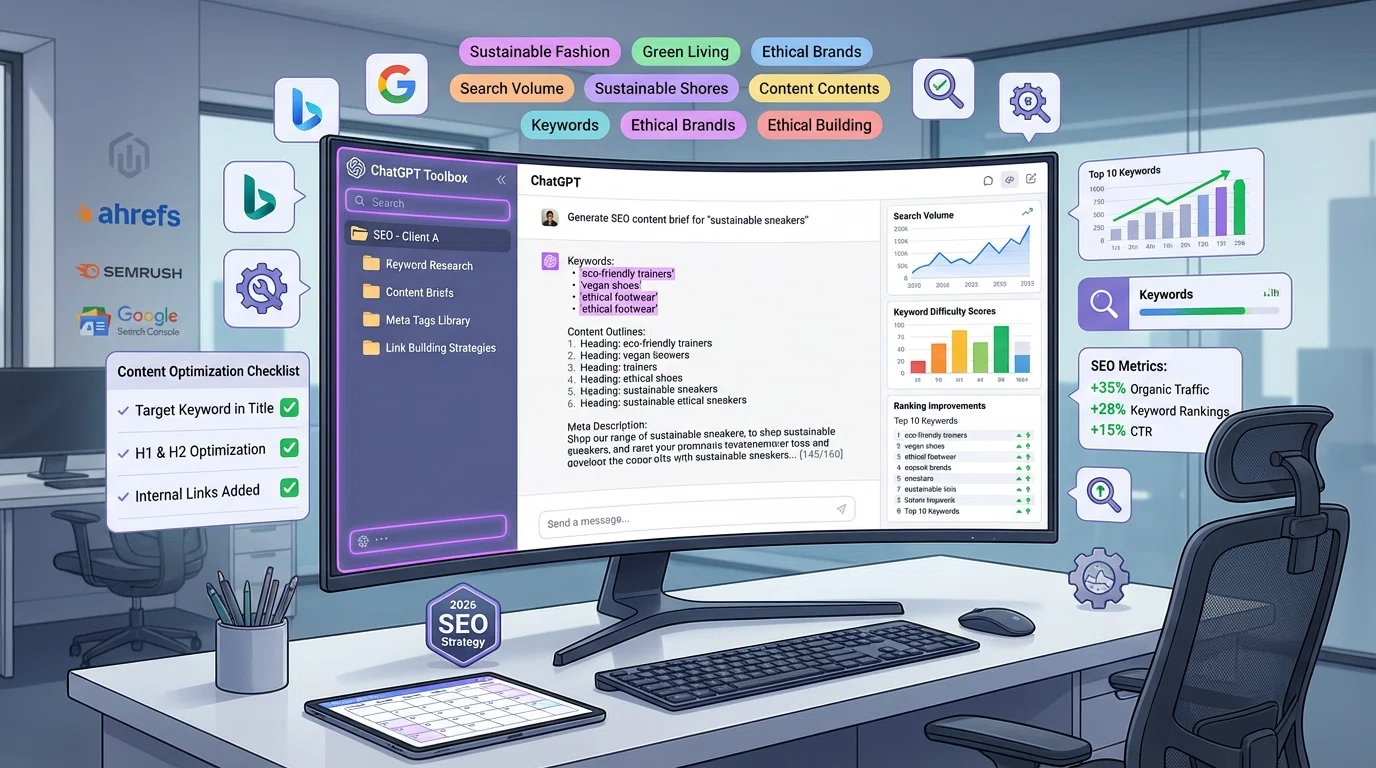
Why ChatGPT Matters for SEO in 2026
The SEO industry has fundamentally changed. According to recent reports, SEO isn't just about ranking on Google anymore—it's about showing up in AI search engines and large language models like ChatGPT, Perplexity, and Gemini. This shift has created an entirely new discipline called Generative Engine Optimization (GEO).
ChatGPT accelerates virtually every SEO task by 2-5x:
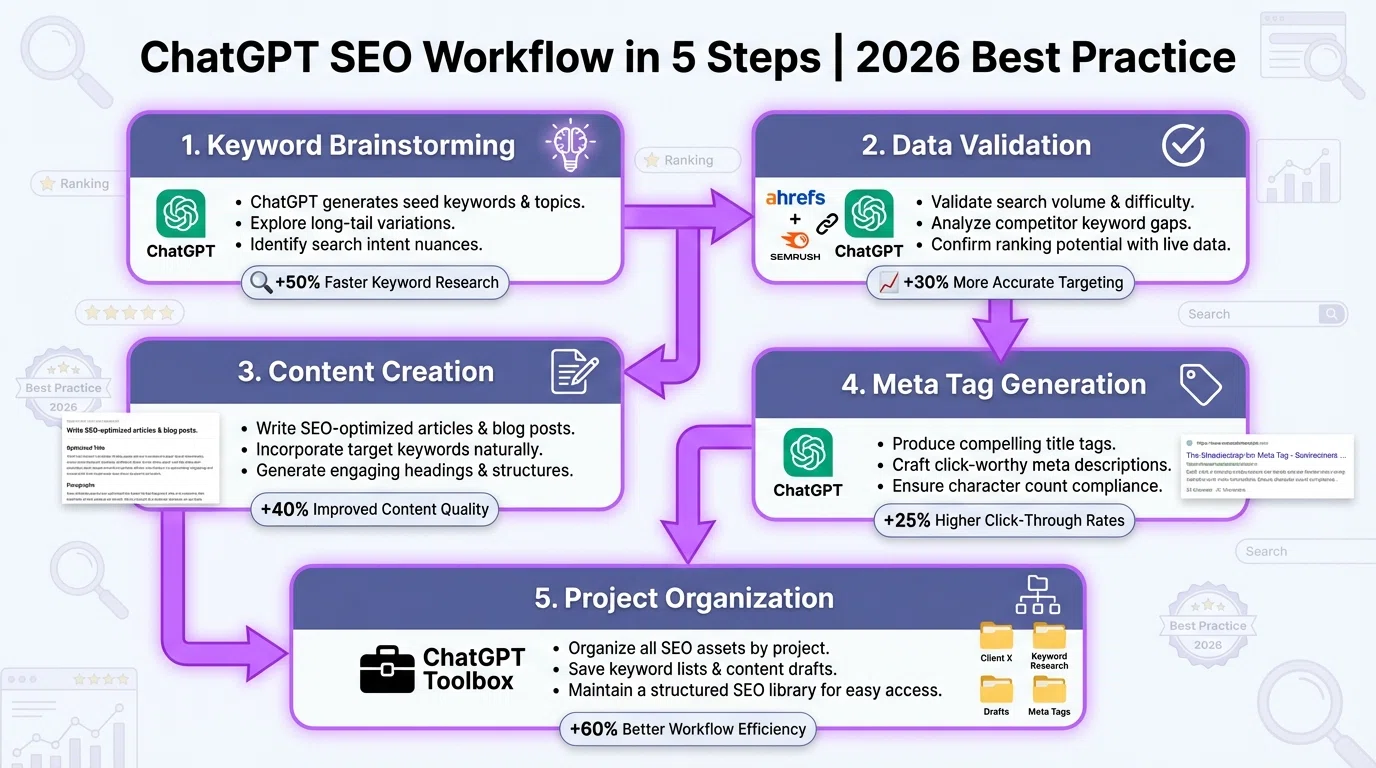
- Keyword Research: Generate hundreds of seed keywords, long-tail variations, and semantic clusters in minutes instead of hours
- Content Briefs: Create comprehensive content outlines with proper heading structure and target keywords
- Meta Tags: Write compelling title tags and meta descriptions at scale (under 155 characters)
- Competitor Analysis: Analyze competitor content strategy and identify content gaps
- Technical SEO: Generate schema markup, hreflang tags, and robots.txt rules
- Project Management: Organize SEO workflows with ChatGPT Toolbox organization features
The key insight from SEO experts in 2026: ChatGPT is exceptional for ideation and content creation, but it must be paired with traditional SEO tools for data validation. ChatGPT can't tell you actual search volume, keyword difficulty, or current rankings—that's where Ahrefs, SEMrush, and Google Search Console remain essential.
1. Keyword Research with ChatGPT: The Smart Approach
ChatGPT excels at brainstorming keyword ideas, long-tail questions, and semantic variations. Use it for keyword ideation, then validate everything with dedicated keyword research tools.
Effective Keyword Research Prompts
Here are battle-tested ChatGPT prompts that SEO professionals use in 2026:
"I run a [type of business] targeting [audience]. Generate 30 seed keywords related to [main topic]. Group them into 3 categories: informational, commercial, and transactional intent."
"Generate 20 long-tail keyword variations for the primary keyword '[your keyword]'. Focus on question-based queries that potential customers might ask in 2026."
"Take these 50 keywords: [paste your list]. Group them into 5-7 topic clusters based on semantic similarity and search intent. Label each cluster with a pillar topic name."
"My website covers [topics A, B, C]. My competitor ranks for [competitor topics]. What keyword opportunities am I missing? Suggest 15 content ideas to fill these gaps."
Critical best practice: After ChatGPT generates keywords, immediately validate them in Ahrefs, SEMrush, or Google Keyword Planner. Check actual search volume and keyword difficulty before committing to content creation. Save your validated keyword lists in ChatGPT Toolbox custom prompts for quick access.
Advanced: Keyword Intent Classification
ChatGPT is remarkably good at classifying keywords by search intent—a time-consuming task when done manually:
"Classify these 100 keywords into 4 categories: Informational, Navigational, Commercial Investigation, and Transactional. Present results in a table with columns: Keyword | Intent | Recommended Content Type."
[Paste your keyword list]
2. Content Optimization with ChatGPT
Content optimization is where ChatGPT truly shines. It can analyze your existing content, identify improvements, and restructure articles for better SEO performance.
Content Optimization Prompts
"Create a comprehensive blog outline for the keyword '[target keyword]' that could rank in position 1-3. Include:
- H1 title (60 characters max)
- 8-12 H2 sections with descriptive subheadings
- 3-4 H3 subsections under each H2
- Suggested word count for each section
- Internal linking opportunities
- FAQ questions to include"
"Analyze this article and suggest SEO improvements:
[Paste your content]
Focus on: heading hierarchy, keyword density, readability (Flesch score), internal linking opportunities, semantic keyword gaps, and featured snippet potential."
"Rewrite this section to target Google featured snippets for the question '[your question]'. Provide:
- A concise 40-60 word answer paragraph
- A numbered list or bulleted format if applicable
- A simple table format if comparing options"
Use ChatGPT Toolbox search functionality to quickly find previous content optimization conversations and reuse successful strategies across multiple articles.
3. Meta Descriptions and Title Tags: ChatGPT's Superpower
Writing compelling meta descriptions and title tags at scale is tedious. ChatGPT can generate dozens of variations in seconds, maintaining the critical character limits while maximizing click-through rates.
Meta Description Best Practices for 2026
- Character limit: Keep under 155 characters (some sources say 160, but 155 is safer)
- Include target keyword: Google bolds matching search terms
- Add a call-to-action: "Learn how," "Discover," "Get started," etc.
- Make it compelling: Focus on user benefit, not just keyword stuffing
Proven Meta Tag Prompts
"Write 10 meta description variations (under 155 characters each) for a blog post titled '[Your Title]'. Target keyword: '[keyword]'. Make them action-oriented and emphasize user benefits. Number each variation."
"Generate 8 SEO-optimized title tag options (under 60 characters) for a page about '[topic]'. Include the primary keyword '[keyword]' and a compelling angle. Optimize for click-through rate from search results."
"Create 2 contrasting meta description styles for '[topic]':
Version A: Data-driven and authoritative (stats, numbers, expert angle)
Version B: Benefit-focused and emotional (transformation, pain points, solutions)
Both under 155 characters."
Pro tip: Save your best-performing meta tag prompts in ChatGPT Toolbox's prompt library for instant reuse across campaigns.
4. Technical SEO Tasks with ChatGPT
While ChatGPT can't audit your actual website, it's excellent for generating technical SEO elements and checklists.
Technical SEO Prompts
"Generate JSON-LD schema markup for a [Article/Product/FAQ/Review] page with these details:
- Title: [title]
- Author: [name]
- Date Published: [date]
- Description: [description]
Follow Schema.org best practices for 2026."
"Create a robots.txt file for an e-commerce website that:
- Allows all major search engines
- Blocks crawling of /cart, /checkout, /admin
- References XML sitemap
- Follows 2026 best practices"
"Generate hreflang tags for a website with these language versions:
- English (US): example.com
- Spanish (Mexico): example.com/es-mx
- French (France): example.com/fr-fr
Include proper x-default implementation."
"Create a comprehensive technical SEO audit checklist for 2026 covering: site speed, mobile-friendliness, crawlability, indexation, schema markup, security (HTTPS), Core Web Vitals, and structured data. Organize by priority: Critical, High, Medium, Low."
5. ChatGPT SEO: Optimizing for AI Search (GEO)
In 2026, a revolutionary concept has emerged: ChatGPT SEO, also known as Generative Engine Optimization (GEO). This refers to optimizing your content so that AI-powered systems like ChatGPT, Perplexity, Google AI Overviews, and Gemini include your brand in their synthesized answers.
Key Differences: Traditional SEO vs. ChatGPT SEO
- Traditional SEO: Optimize for ranking specific pages on search engine results pages (SERPs)
- ChatGPT SEO (GEO): Optimize to be cited and referenced when AI models answer questions
How to Optimize for ChatGPT SEO in 2026
- Semantic Richness over Keyword Density: AI models favor content with comprehensive coverage of a topic, not just keyword repetition
- Structured Data is Critical: Schema markup helps AI models understand your content context and authority
- Entity-Based Content: Focus on establishing your brand as an entity with clear expertise areas
- Authoritative Sources: Citations, references, and links to credible sources improve AI trust signals
- Clear, Direct Answers: Start sections with concise answers before elaborating—AI models often extract these
"Rewrite this content section to optimize for Generative Engine Optimization (GEO) in 2026. Ensure:
- Clear, direct answer in the first 40-50 words
- Semantic richness (related concepts, entities, context)
- Natural inclusion of authoritative references
- Structured format (lists, tables where applicable)
- Expert positioning without keyword stuffing
Original content:
[Paste your content]"
6. Organizing SEO Projects with ChatGPT Toolbox
Managing multiple SEO clients, campaigns, and content projects in ChatGPT can quickly become chaotic. Without proper organization, you'll waste hours searching for previous keyword research, content briefs, or competitor analyses.
ChatGPT Toolbox: Your SEO Command Center
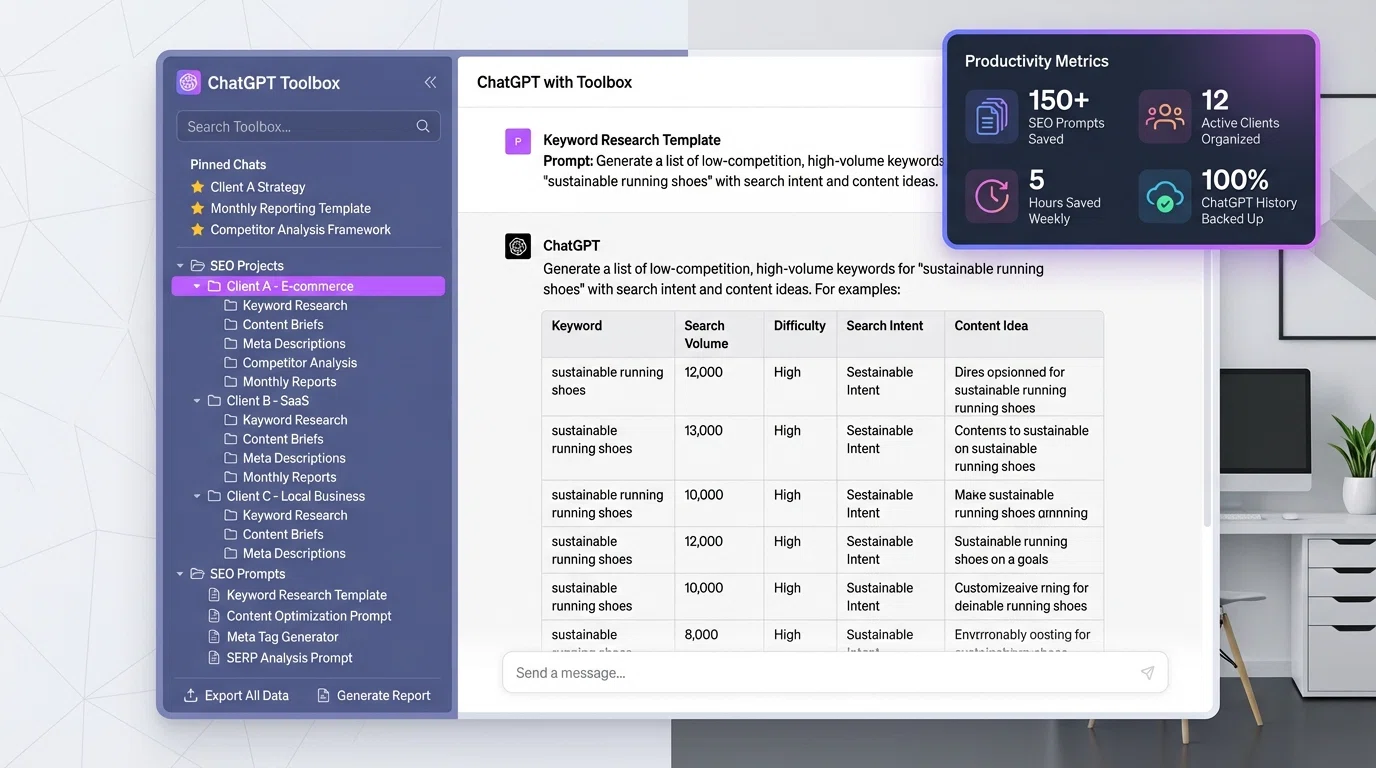
ChatGPT Toolbox folders transform ChatGPT into a professional SEO management system:
Recommended Folder Structure for SEO Professionals
- 📁 SEO Projects
- 📁 Client A - E-commerce
- 📁 Client B - SaaS
- 📁 Client C - Local Business
- 📁 Keyword Research
- 📁 Main Keywords
- 📁 Long-Tail Opportunities
- 📁 Competitor Keywords
- 📁 Content Briefs
- 📁 Blog Posts
- 📁 Landing Pages
- 📁 Category Pages
- 📁 Meta Tags Library
- 📁 Approved Meta Descriptions
- 📁 Title Tag Variations
- 📁 SEO Prompt Templates
Essential ChatGPT Toolbox Features for SEO
- Advanced Search: Find any keyword research or content brief instantly across thousands of conversations
- Custom Prompts: Save your best SEO prompts for one-click access (keyword research, meta tags, content outlines)
- Bulk Export: Export SEO conversations to share with clients or archive for reporting
- Pin Important Chats: Keep active client projects pinned at the top for quick access
- Automated Backups: Never lose your SEO research with automatic conversation backups
Real-World SEO Workflow with ChatGPT Toolbox
- Morning: Open "SEO - Client A" folder, review pinned active projects
- Keyword Research: Use saved prompt template "Keyword Research Template", save results in appropriate folder
- Content Creation: Open "Content Briefs" folder, generate outline using saved prompt, organize by content type
- Meta Tags: Generate 10 variations using "Meta Tag Generator" prompt, save winners in "Approved Meta Descriptions" folder
- Client Reporting: Use search functionality to find all Client A conversations, bulk export for monthly report
This systematic organization saves SEO professionals 5-10 hours per week by eliminating time wasted searching for previous work.
7. Limitations: What ChatGPT Can't Do for SEO
Despite its power, ChatGPT has clear limitations in SEO workflows. Understanding these boundaries prevents costly mistakes.
ChatGPT Cannot:
- Provide real search volume data: ChatGPT can't tell you that "ChatGPT for SEO" has 500 monthly searches with KD 22
- Show keyword difficulty scores: You need Ahrefs, SEMrush, or similar tools for competitive analysis
- Check current rankings: ChatGPT doesn't know where your site ranks for any keyword
- Audit your actual website: Technical SEO audits require tools like Screaming Frog or Sitebulb
- Access live SERP data: ChatGPT can't analyze current search results or featured snippets (unless using web search mode)
- Track backlinks: Link building analysis requires specialized tools
- Guarantee rankings: AI-generated content still needs human review, editing, and optimization
The Hybrid Approach: ChatGPT + Traditional SEO Tools
The most successful SEO professionals in 2026 use this workflow:
- ChatGPT: Brainstorm keywords, create content outlines, write meta tags, generate schema markup
- Traditional Tools (Ahrefs/SEMrush): Validate keywords with real search volume and difficulty data
- ChatGPT: Create optimized content based on validated keyword targets
- Human Editor: Review, fact-check, and add unique insights AI can't replicate
- ChatGPT Toolbox: Organize and archive all SEO work for team collaboration and client reporting
8. Advanced ChatGPT SEO Strategies
Strategy 1: Prompt Chaining for Complete SEO Content
Use ChatGPT Toolbox prompt chaining to automate multi-step SEO workflows:
- Prompt 1: Generate 30 keyword ideas → Output: Keyword list
- Prompt 2: Classify keywords by intent → Output: Categorized keywords
- Prompt 3: Create content outline for top informational keyword → Output: Blog outline
- Prompt 4: Generate 10 meta descriptions for this topic → Output: Meta tag options
- Prompt 5: Write FAQ schema markup for these questions → Output: JSON-LD code
Strategy 2: Competitor Content Gap Analysis
"I cover these topics on my website: [list your content topics]. My top 3 competitors cover these additional topics: [list competitor topics from Ahrefs content gap analysis].
Analyze the gap and recommend 20 new content ideas ranked by:
1. Relevance to my existing content
2. Potential to attract my target audience
3. Difficulty level (beginner to advanced)
Present in a table format with columns: Topic Idea | Relevance Score | Estimated Difficulty | Primary Keyword Target."
Strategy 3: Local SEO Optimization
"Generate a local SEO content strategy for a [type of business] in [city, state]. Include:
- 15 location-specific keyword targets
- 10 'near me' query variations
- Local schema markup requirements
- 5 location pages outline suggestions
- Google Business Profile optimization checklist"
Conclusion: ChatGPT + Smart Organization = SEO Success
ChatGPT has become an indispensable tool for SEO professionals in 2026, but success requires three things:
- Strategic Prompting: Use specific, detailed prompts that align with SEO best practices
- Data Validation: Always verify ChatGPT's keyword suggestions with tools like Ahrefs or SEMrush before committing to content creation
- Systematic Organization: Use ChatGPT Toolbox to organize your SEO projects, save successful prompts, and maintain a searchable knowledge base
The most efficient SEO workflows combine ChatGPT's creative intelligence with traditional tools' hard data, all organized within ChatGPT Toolbox's folder system. This hybrid approach delivers the best of both worlds: AI-accelerated content creation with data-backed strategic decisions.
Ready to transform your SEO workflow? Start by organizing your ChatGPT conversations with ChatGPT Toolbox, save your best SEO prompts for instant reuse, and build a systematic approach to managing multiple clients and campaigns.
Frequently Asked Questions
Can ChatGPT help with SEO?
Yes, ChatGPT is excellent for SEO tasks including keyword research, content optimization, meta description writing, title tag generation, content outlining, and competitor analysis. In 2026, ChatGPT SEO has become a standard practice, helping marketers optimize for both traditional search engines and AI-powered search platforms like ChatGPT itself and Perplexity.
What SEO tasks can ChatGPT do?
ChatGPT can help with keyword research (generating seed keywords, long-tail variations, semantic clusters), content optimization (improving readability, structure, keyword integration), meta tag creation, content outlining, competitor analysis, technical SEO audit checklists, schema markup generation, and organizing SEO projects. It excels at brainstorming and structuring but requires validation with tools like Ahrefs or SEMrush.
Can ChatGPT do keyword research?
ChatGPT can brainstorm keyword ideas, suggest long-tail variations, group keywords into clusters, and identify search intent. However, it cannot provide real search volume data or keyword difficulty scores. Best practice in 2026 is to use ChatGPT for keyword ideation and clustering, then validate terms in dedicated tools like Ahrefs, SEMrush, or Google Search Console for actual metrics.
Can ChatGPT write meta descriptions?
Yes, ChatGPT is excellent at writing meta descriptions under 155 characters with compelling calls-to-action. Use prompts like: "Write 5 meta description variations (under 155 characters) for a blog post titled [Your Title]. Make them engaging and action-oriented." ChatGPT can generate multiple variations quickly, which you can then test and optimize.
What is ChatGPT SEO optimization?
ChatGPT SEO optimization refers to optimizing your web content, technical presence, and entity signals so AI-powered assistants like ChatGPT, Perplexity, and Google AI Overviews include your brand when synthesizing answers. In 2026, this is called Generative Engine Optimization (GEO), where semantic richness and structured data are stronger visibility drivers than isolated keyword usage.
Can ChatGPT replace SEO tools like Ahrefs or SEMrush?
No, ChatGPT cannot replace dedicated SEO tools. While ChatGPT excels at keyword ideation, content optimization, and strategic planning, it lacks real-time data on search volume, keyword difficulty, backlinks, rankings, and competitor metrics. The best SEO workflow in 2026 combines ChatGPT for ideation and content creation with tools like Ahrefs, SEMrush, or Google Search Console for data validation.
How do I organize SEO projects with ChatGPT Toolbox?
ChatGPT Toolbox helps organize SEO projects by letting you create dedicated folders for each client or campaign, save SEO prompt templates for quick access, search your SEO research history efficiently, and export conversations for reporting. Create folders like "SEO - [Client Name]", save prompts for keyword research, content briefs, and meta tags, and keep all related chats organized in one place.
Sources:
- 36 Best ChatGPT Prompts for SEO in 2026 [Expert Sourced] | Juma
- ChatGPT for SEO: Ultimate Guide, Tips & Prompts for 2026 | Backlinko
- ChatGPT SEO Optimization: 12 Tips to Boost Visibility in 2026 | Startup Voyager
- Best ChatGPT SEO Strategies and Tips for 2026 | NEWMEDIA.COM
- ChatGPT for SEO: Powerful Prompts & Optimization Tips for 2026 | Bluehost
- We Tested 13 Best AI SEO Content Optimization Tools | Rankability
- 9 AI SEO Tools I Tested in 2026 | Self Made Millennials
- 14 ChatGPT Meta Description Prompts | AirOps
