
 Add to Chrome
 Add to Edge
 Adi Leviim
ChatGPT O1 vs GPT-4: Which Model Should You Use?
Choosing between ChatGPT O1 and GPT-4 can dramatically impact your productivity and results. With O1's revolutionary chain-of-thought reasoning solving 83% of International Mathematical Olympiad problems compared to GPT-4's 13%, yet GPT-4 generating responses 3-5x faster, the decision isn't straightforward. In 2026, both models serve distinct purposes—O1 excels at complex reasoning, advanced coding, and scientific research, while GPT-4 dominates general conversation, creative writing, and speed-critical tasks. This comprehensive comparison breaks down performance, speed, accuracy, pricing, and real-world use cases to help you select the right model for your needs. Whether you're a researcher, developer, content creator, or power user, discover exactly when to use O1 vs GPT-4 for maximum effectiveness.
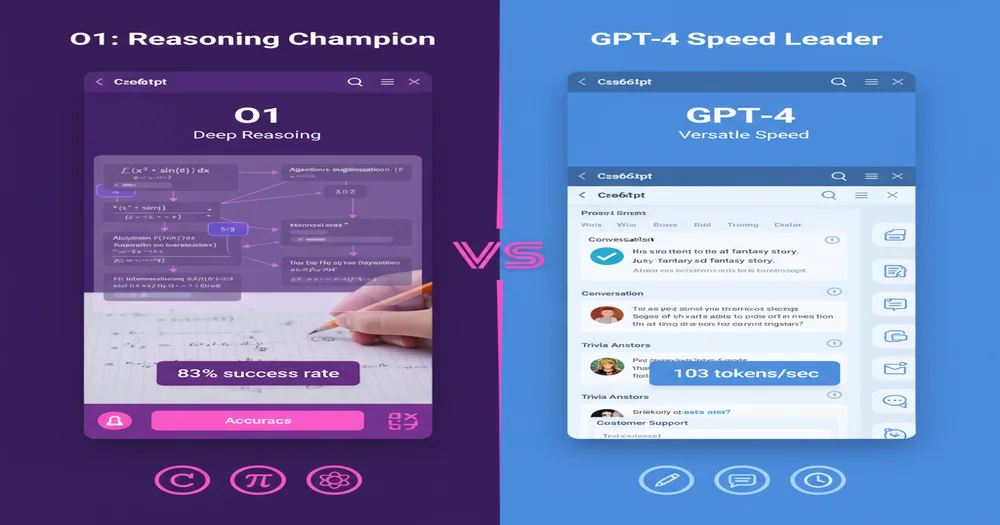
ChatGPT O1 vs GPT-4: Quick Comparison Table (2026)
Before diving into details, here's a side-by-side comparison highlighting the most significant differences between ChatGPT O1 and GPT-4 in 2026.
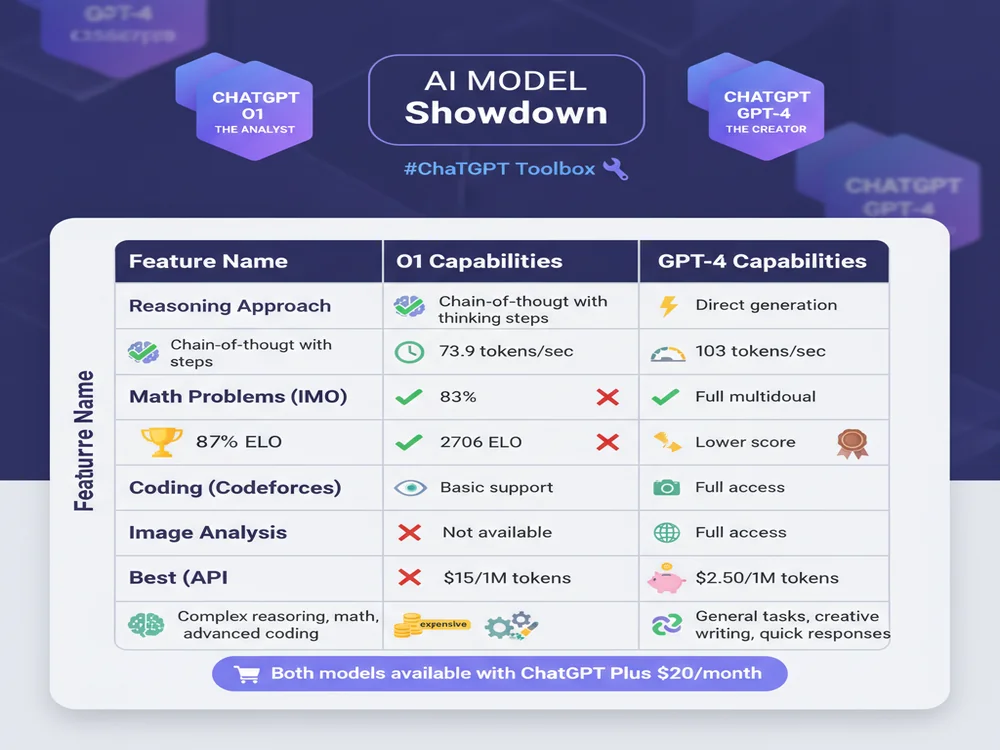
| Feature | ChatGPT O1 | GPT-4 |
|---|---|---|
| Reasoning Approach | Chain-of-thought (thinks before answering) | Direct generation (instant responses) |
| Response Speed | 73.9 tokens/sec (O1-mini), 30-60s for complex tasks | 103 tokens/sec (GPT-4o), 2-5 seconds average |
| Math (IMO 2024) | 83% success rate | 13% success rate |
| Coding (Codeforces) | 2706 ELO (expert level) | 1891 ELO (intermediate) |
| Science (GPQA Diamond) | 78% accuracy (PhD-level questions) | Lower performance |
| Image Analysis | ✓ Available (added 2026) | ✓ Full multimodal support |
| Web Browsing | ✗ Not available (planned) | ✓ Real-time web access |
| File Uploads | Limited | Full support (PDFs, docs, images) |
| API Cost | $15 per 1M input tokens (O1-preview) | $2.50 per 1M tokens (GPT-4o) |
| Availability | Plus ($20/mo), Pro ($200/mo for O1-pro) | Free tier + Plus ($20/mo) |
| Best For | Complex reasoning, math, advanced coding, research | General chat, creative writing, quick tasks, content |
Both models work seamlessly with ChatGPT Toolbox, which adds essential organization features like advanced search, bulk export, folders, and prompt libraries to help you manage conversations from both O1 and GPT-4 efficiently.
Understanding ChatGPT O1's Chain-of-Thought Reasoning
The fundamental difference between O1 and GPT-4 lies in how they think. ChatGPT O1 uses chain-of-thought reasoning—a technique that mimics human problem-solving by breaking down complex tasks into intermediate steps.
How O1's Reasoning Works
When you ask O1 a challenging question, it doesn't rush to answer. Instead, the model:
- Analyzes the problem by identifying key components and requirements
- Explores multiple approaches by considering different solution strategies
- Identifies potential mistakes through self-verification and error checking
- Refines the solution by correcting errors and optimizing the approach
- Delivers the final answer with confidence after extended thinking
This deliberate process takes longer—sometimes 30-60 seconds for complex problems—but produces significantly more accurate results. According to OpenAI, O1 correctly solved 83% of tasks in the International Mathematical Olympiad qualifying exam, while GPT-4o managed only 13%.
Why GPT-4 Responds Faster
GPT-4, in contrast, generates responses directly without extended reasoning phases. This makes it ideal for:
- Quick factual questions requiring instant answers
- Creative writing where fluency matters more than deep analysis
- General conversation and customer support scenarios
- Brainstorming sessions needing rapid idea generation
- Content creation with tight deadlines
Reality check: O1's thinking process adds 5-10x more time per response, but for complex problems requiring accuracy—mathematical proofs, scientific research, competitive programming—this investment pays off with dramatically better results.
To organize your conversations with both models, export important chats or use folders to organize by model type with ChatGPT Toolbox.
Speed Comparison: O1 vs GPT-4 Performance Data
Response speed differences between ChatGPT O1 and GPT-4 are substantial. Here's what independent testing reveals in 2026:
| Task Type | O1 Speed | GPT-4 Speed | Winner |
|---|---|---|---|
| Simple question | 8-12 seconds | 2-3 seconds | GPT-4 (4x faster) |
| Complex reasoning task | 30-60 seconds | 5-10 seconds | GPT-4 (6x faster) |
| Mathematical proof | 45-90 seconds | 10-15 seconds | O1 (better accuracy) |
| Code generation (simple) | 10-15 seconds | 3-5 seconds | GPT-4 (3x faster) |
| Code debugging (complex) | 40-70 seconds | 8-12 seconds | O1 (higher success rate) |
| Creative writing | 15-25 seconds | 4-6 seconds | GPT-4 (4x faster) |
| Scientific research analysis | 50-90 seconds | 10-15 seconds | O1 (deeper insights) |
Token Generation Rates
According to technical benchmarks, GPT-4o generates at 103 tokens per second, while O1-mini produces 73.9 tokens per second. The full O1 model is even slower due to extended reasoning phases that aren't reflected in simple token counts.
Time savings example: For a developer generating 50 responses daily, GPT-4 saves approximately 15-20 minutes compared to O1. However, for 10 complex debugging tasks daily, O1's higher accuracy may save hours by reducing trial-and-error iterations.
Accuracy and Reasoning: When O1 Dominates
ChatGPT O1's extended reasoning delivers exceptional performance in specific domains where accuracy matters more than speed:
Mathematics and Logic
O1 demonstrates superior mathematical reasoning capabilities:
- AIME 2024 (Competition Math): O1 scored 74.3% vs GPT-4's lower performance
- IMO Qualifying Exam:O1 solved 83% of problems vs GPT-4o's 13%
- Complex proofs: O1 shows step-by-step reasoning reducing logic errors by 60-70%
Advanced Coding and Algorithms
For competitive programming and complex software engineering tasks, O1 significantly outperforms GPT-4:
- Codeforces ELO: O1 achieved 2706 (expert tier) vs GPT-4's 1891 (intermediate)
- Algorithm optimization: O1 identifies time complexity improvements GPT-4 misses
- Debugging complex systems: O1's systematic approach catches subtle logic errors
- System architecture: O1 considers edge cases and scalability factors more thoroughly
Scientific Research and Analysis
O1 excels at PhD-level scientific reasoning:
- GPQA Diamond (PhD-level science questions): O1 scored 78% accuracy
- Research hypothesis generation: O1 explores multiple theoretical frameworks systematically
- Experimental design: O1 identifies potential confounding variables more consistently
- Literature synthesis: O1 connects concepts across disciplines with deeper analysis
For organizing research conversations, use bulk export features to save important O1 research sessions locally.
When to Use GPT-4 Instead of O1
Despite O1's reasoning advantages, GPT-4 remains the better choice for many everyday use cases where speed, versatility, and multimodal capabilities matter most:
Content Creation and Writing
GPT-4 excels at creative and professional writing tasks:
- Blog posts and articles: GPT-4 generates flowing, engaging content 4-5x faster
- Social media content: Quick, creative responses with appropriate tone and style
- Email drafting: Professional communication doesn't benefit from extended reasoning
- Marketing copy: GPT-4's versatility handles various formats and audiences effectively
Manage your content creation workflow with prompt templates to accelerate GPT-4 content generation.
General Conversation and Customer Support
Speed-critical applications favor GPT-4:
- Customer service chatbots: 2-3 second response times create better user experiences
- General Q&A: Most questions don't require O1's extended thinking
- Brainstorming sessions: Rapid idea generation benefits from GPT-4's speed
- Quick fact lookups: Direct answers beat extended reasoning when accuracy isn't critical
Multimodal Tasks Requiring Web Access
GPT-4 maintains significant feature advantages in 2026:
- Web browsing: GPT-4 accesses current information; O1 doesn't browse web yet
- Document analysis: GPT-4 handles PDFs, Word docs, spreadsheets; O1 support is limited
- Image generation prompting: GPT-4 integrates with DALL-E seamlessly
- Real-time data needs: GPT-4's web access provides up-to-date information
For tasks requiring image inputs, O1 now supports image analysis as of 2026, though GPT-4's multimodal capabilities remain more comprehensive.
Pricing and Availability: O1 vs GPT-4 Access
Understanding the cost and availability differences helps determine which model fits your budget and needs:
ChatGPT Plus Subscription ($20/month)
Both models are available through ChatGPT Plus with usage limits:
- GPT-4 access: 160 messages every 3 hours (GPT-5.2 in 2026)
- O1 access: Approximately 50 O1 messages per week
- O1-mini: Higher message limits for faster O1 variant
- Model switching: Manual selection between models in interface
ChatGPT Pro Subscription ($200/month)
For users needing maximum O1 capability:
- O1-pro mode: Most powerful O1 variant with 86% AIME success rate
- Unlimited O1 access: No weekly message restrictions
- Priority compute: Faster O1 responses during peak usage
- All GPT-4 features: Full access to standard models included
API Pricing (For Developers)
| Model | Input Cost | Output Cost |
|---|---|---|
| GPT-4o | $2.50 per 1M tokens | $10 per 1M tokens |
| O1-preview | $15 per 1M tokens | $60 per 1M tokens |
| O1-mini | $3 per 1M tokens | $12 per 1M tokens |
Cost-benefit analysis: O1 costs 6x more via API than GPT-4o. For applications where 10-20% accuracy improvements justify 6x higher costs (medical diagnosis assistance, financial analysis, legal research), O1 makes sense. For high-volume chatbots or content generation, GPT-4 provides better ROI.
Real-World Use Cases: Which Model to Choose
Here are practical scenarios showing when each model excels:
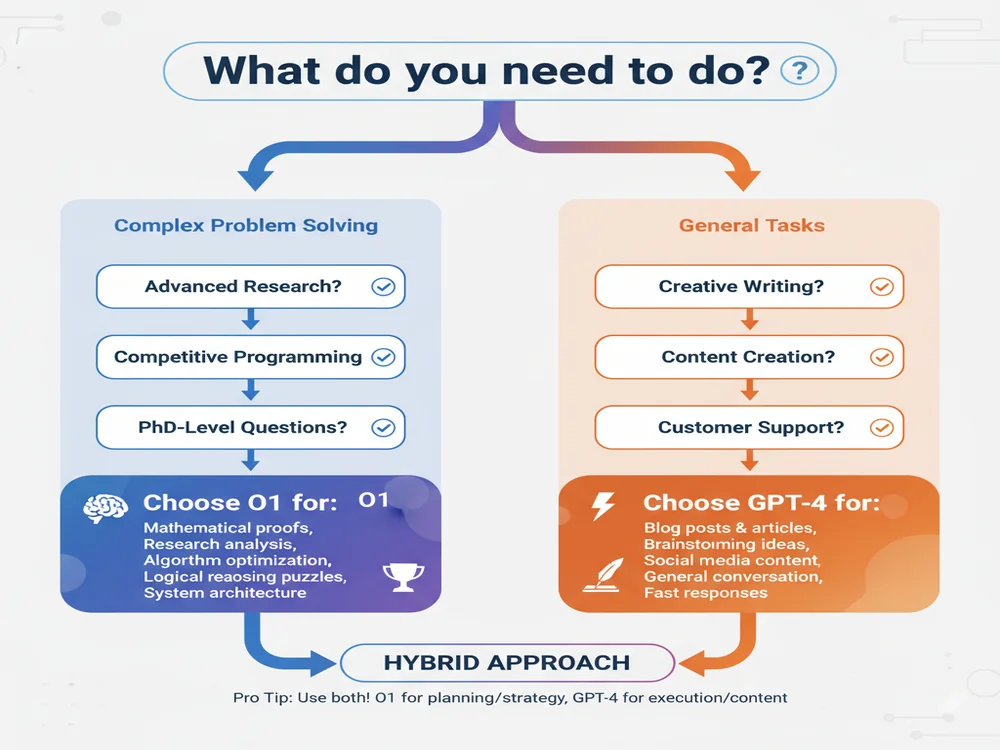
Choose ChatGPT O1 For:
- Mathematical research: Proving theorems, solving competition math problems, statistical analysis requiring rigorous verification
- Advanced software engineering: System architecture design, algorithm optimization, debugging complex distributed systems
- Scientific hypothesis testing: Analyzing experimental designs, identifying confounding variables, literature review synthesis
- Strategic business analysis: Multi-factor decision-making, scenario modeling with complex interdependencies
- Legal/medical research: Cases requiring thorough reasoning, edge case identification, risk assessment
- Competitive programming: LeetCode hard problems, Codeforces competitions, algorithm challenges
- PhD-level academic work: Research proposals, dissertation analysis, complex literature synthesis
Choose GPT-4 For:
- Content creation: Blog posts, social media, marketing copy, email newsletters
- Creative writing: Stories, poetry, scripts, dialogue generation
- General coding: Quick scripts, boilerplate code, documentation, code comments
- Customer support: FAQ responses, ticket handling, user guidance
- Brainstorming: Idea generation, concept exploration, creative solutions
- Learning and education: Explaining concepts, tutoring, practice questions (non-competitive)
- Current events: Any task requiring web access or real-time information
- Document analysis: PDF processing, spreadsheet interpretation, image understanding
Hybrid Approach (Best Strategy)
Many professionals use both models strategically:
- Planning with O1: Use O1 to architect solutions, identify edge cases, design algorithms
- Execution with GPT-4: Use GPT-4 to write documentation, generate test cases, create content
- Verification with O1: Return to O1 for code review, bug analysis, logic verification
This hybrid approach maximizes strengths of both models while managing time and cost effectively.
O1 Model Variants: O1-preview, O1-mini, O1-pro
Understanding the O1 family helps optimize your choice:
O1-preview (Full Model)
- Best for: Most challenging reasoning tasks requiring maximum capability
- Speed: Slowest (30-90 seconds for complex tasks)
- Accuracy: Highest reasoning quality
- Cost: Most expensive via API
O1-mini (Efficient Variant)
- Best for: Coding tasks and STEM problems where speed matters more
- Speed: 73.9 tokens/second (faster than full O1)
- Accuracy: Strong on focused tasks, less comprehensive on very complex problems
- Cost: Middle ground ($3/$12 per 1M tokens)
O1-pro Mode (ChatGPT Pro Exclusive)
- Best for: Users needing absolute maximum capability on hardest problems
- Performance: 86% AIME 2024 success rate vs 74.3% for standard O1
- Availability: Requires $200/month ChatGPT Pro subscription
- Use case: Research institutions, advanced developers, professional mathematicians
For more context on ChatGPT models, read our guide on ChatGPT O1 explained or explore all ChatGPT models compared.
Managing Conversations with Both Models
Power users working with both O1 and GPT-4 need effective organization strategies. ChatGPT Toolbox provides essential features for managing conversations across models:
- Folder organization: Create separate folders for "O1 Research," "GPT-4 Content," "O1 Coding," "GPT-4 Brainstorming"
- Advanced search: Find specific O1 mathematical proofs or GPT-4 writing drafts instantly by content
- Bulk export: Save important O1 reasoning chains or GPT-4 creative outputs to local files
- Prompt library: Store optimized prompts for each model type with the prompt library feature
- Pin conversations: Keep critical O1 research sessions or GPT-4 project work accessible
Organize hundreds of conversations efficiently with advanced organization strategies.
Future Development: What's Next for O1 and GPT-4
Based on OpenAI's development roadmap, expect these improvements:
Coming to O1:
- Web browsing capability: Planned addition to access real-time information
- Enhanced file uploads: Full document processing similar to GPT-4
- Function calling: API integration for automated workflows
- System prompts: Better customization for specific use cases
GPT-4 Evolution:
- Speed improvements: Continued optimization for faster token generation
- Enhanced reasoning: Incorporating O1-style thinking for complex tasks when needed
- Better multimodal integration: Improved image/video understanding
As both models evolve, the gap between them may narrow, with GPT-4 gaining reasoning capabilities and O1 adding speed and features.
Frequently Asked Questions
What is the main difference between ChatGPT O1 and GPT-4?
ChatGPT O1 uses chain-of-thought reasoning to spend more time thinking before responding, making it excel at complex problem-solving in math, science, and coding. GPT-4 responds faster and is better for general conversation, creative writing, and quick tasks. O1 solves 83% of IMO math problems vs GPT-4's 13%, but GPT-4 generates responses 3-5x faster.
Is ChatGPT O1 faster than GPT-4?
No, GPT-4 is significantly faster. GPT-4o generates at 103 tokens per second, while O1-mini generates at 73.9 tokens per second. The full O1 model is even slower, taking 30-60 seconds for complex reasoning tasks compared to GPT-4's 2-5 seconds. O1 prioritizes accuracy over speed through extended reasoning processes.
Which model is better for coding?
ChatGPT O1 is superior for complex coding tasks, debugging, and algorithmic challenges. O1 achieves 2706 ELO on Codeforces competitions compared to GPT-4's lower performance. For quick code snippets, documentation, or simple scripts, GPT-4 is faster and sufficient. Use O1 for system architecture, optimization problems, and competitive programming.
Can I use ChatGPT O1 for free?
O1-mini is available to ChatGPT Plus subscribers ($20/month) with limited messages. The full O1 model requires ChatGPT Plus, while O1-pro mode is exclusive to ChatGPT Pro ($200/month). Free tier users cannot access any O1 models as of 2026. ChatGPT Plus users get approximately 50 O1 messages per week.
Does ChatGPT O1 support images and web browsing?
As of 2026, O1 has gained image analysis capabilities but still lacks web browsing and file upload features that GPT-4 offers. OpenAI is gradually adding these features to O1. For tasks requiring real-time web data, document analysis, or multimodal inputs, GPT-4 remains the better choice.
When should I choose O1 over GPT-4?
Choose O1 for: complex math problems, scientific research, advanced coding challenges, PhD-level questions, logical reasoning puzzles, and tasks requiring deep analysis. Choose GPT-4 for: general conversation, creative writing, quick questions, content creation, brainstorming, customer support, and tasks requiring speed over depth.
How much does ChatGPT O1 cost compared to GPT-4?
Both O1 and GPT-4 are included in ChatGPT Plus ($20/month) with message limits. Via API, O1 costs more: O1-preview is $15 per 1M input tokens vs GPT-4o at $2.50 per 1M tokens. O1-mini ($3/$12 per 1M tokens) offers a middle ground. The O1-pro mode requires ChatGPT Pro at $200/month.
Is ChatGPT O1 worth the upgrade from GPT-4?
O1 is worth using if you regularly work on complex problems requiring deep reasoning—research, advanced mathematics, competitive programming, or strategic analysis. For most general users doing creative writing, chatting, simple coding, or content creation, GPT-4 provides better speed and versatility. Plus subscribers get access to both, so test O1 for your specific use cases.
Conclusion: Making the Right Choice
The choice between ChatGPT O1 and GPT-4 depends entirely on your use case. O1's revolutionary chain-of-thought reasoning makes it unmatched for complex problem-solving, advanced mathematics, and challenging coding tasks where accuracy justifies longer response times. GPT-4's speed, versatility, and mature feature set make it ideal for general conversation, content creation, and the vast majority of everyday AI interactions.
For most users, the optimal strategy is using both models strategically: O1 for planning, architecture, and complex analysis; GPT-4 for execution, content creation, and quick responses. ChatGPT Plus subscribers get access to both for $20/month, making it easy to experiment and find your ideal workflow.
Maximize productivity with both models by organizing your conversations effectively. Download ChatGPT Toolbox to add advanced search, bulk export, folders, and prompt libraries—making it easy to manage conversations from O1 and GPT-4 in one organized system. Get started free today.
