
 Add to Chrome
 Add to Edge
 Adi Leviim
AI Tools for Developers: 20+ Best Coding Assistants (2026)
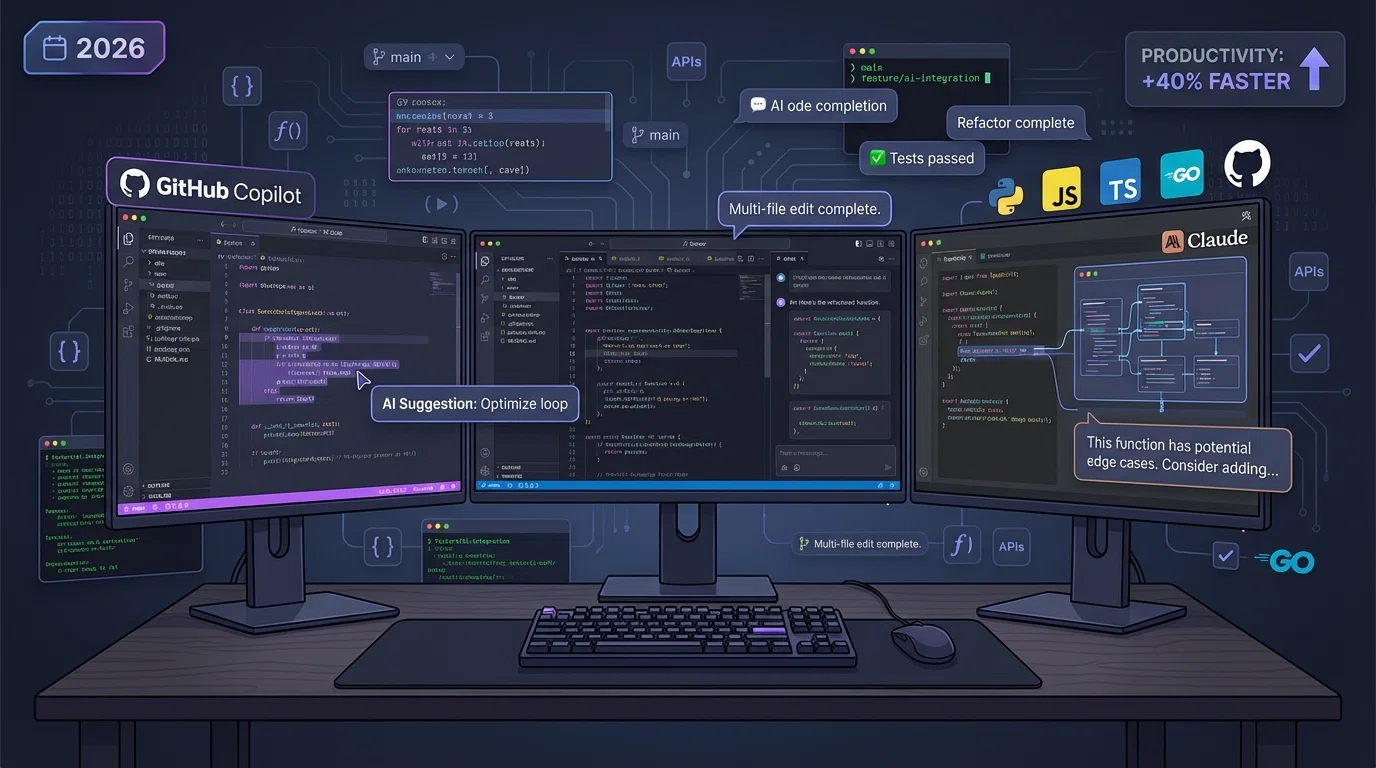
The development landscape has fundamentally changed in 2026. Approximately 85% of developers now regularly use AI coding assistants, with AI writing as much as 30% of Microsoft's code and over 25% of Google's. What started as experimental autocomplete has evolved into sophisticated coding agents that understand entire codebases, autonomously refactor across multiple files, and generate functional applications from natural language descriptions.
In this comprehensive guide, we'll compare the 20+ best AI coding tools for developers in 2026—from industry-standard GitHub Copilot to emerging powerhouses like Cursor and Replit Agent. You'll learn which tools deliver real productivity gains, how to choose based on your workflow, and why ChatGPT Toolbox is essential for organizing your AI-assisted coding conversations.
The State of AI Coding Tools in 2026
Generative AI's ability to write software code has created one of the technology's first real use cases for business, with professional engineers and novices using AI to produce, test, edit, and debug code.
Key statistics for 2026:
- 85% adoption rate: Most developers now use AI tools regularly
- 30-40% productivity increase: Developers report significant time savings
- Enterprise integration: AI writes 30% of code at Microsoft, 25%+ at Google
- Reduced mental load: The real advantage is cognitive freedom, not just speed
- Workflow integration: The differentiator is no longer model quality but workflow fit
As one expert notes, "Model quality still matters, but it's no longer the differentiator it once was—what separates the best tools now is how well they integrate with your workflow."
Best AI Coding Assistants: Comprehensive Comparison
1. GitHub Copilot - Best Overall (Industry Standard)
What it is:GitHub Copilot stands out as the best overall AI coding assistant for 2026, explicitly designed to be an AI pair programmer capable of writing functional code across multiple languages.
Key features:
- IDE Integration: Works in VS Code, JetBrains, Visual Studio, Neovim
- Real-Time Suggestions: Context-aware code completion as you type
- GitHub Ecosystem: Deep integration with GitHub workflows
- Multi-Language Support: Python, JavaScript, Go, PHP, Ruby, Swift, TypeScript, and more
- Enterprise Features: Advanced security, IP indemnity, audit logs
- Chat Interface: Ask coding questions directly in your IDE
Pricing (2026):
- Individual: $10/month or $100/year
- Business: $39/user/month (minimum 2 seats)
- Enterprise: Custom pricing with advanced governance
- Free: For verified students, teachers, and popular open-source maintainers
Performance benchmarks: GitHub Copilot achieved a 56.5% resolution rate, solving 283 of 500 benchmark tasks.
Best for: Enterprise teams, developers within the GitHub ecosystem, and anyone wanting reliable, well-integrated AI assistance that works across multiple IDEs.
2. Cursor - Best AI-Native Editor
What it is:Cursor is VS Code rebuilt with AI at the center, keeping everything you already rely on while adding AI that understands your entire repository.
Key features:
- Composer Mode: AI works on multiple files at once in autonomous, agent-like manner
- Full Codebase Context: AI understands your entire project, not just the current file
- Model Flexibility: Choose between GPT-4, Claude, or other models
- Multi-File Editing: Apply changes across dozens of files simultaneously
- VS Code Compatible: All your extensions and settings work
- Fast Iteration: Significantly faster for complex refactoring tasks
Pricing (2026):
- Pro: $20/month (individual developers)
- Business: $40/user/month (teams, advanced features)
Performance benchmarks:Cursor completed tasks in 62.95 seconds vs Copilot's 89.91, though with a slightly lower 51.7% resolution rate.
Best for: Developers handling complex codebases, multi-file refactoring, and those who want the most advanced AI-native editing experience available in 2026.
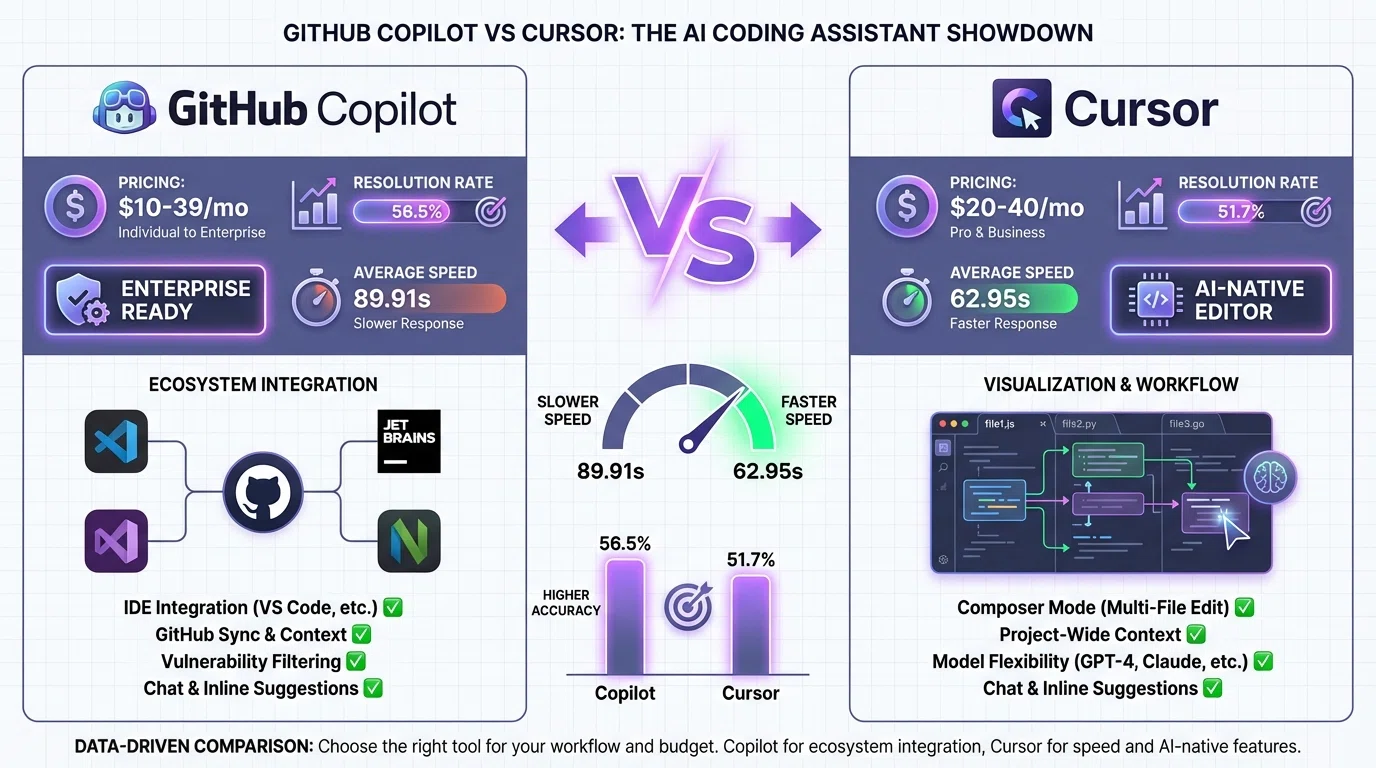
GitHub Copilot vs Cursor: Direct Comparison
The Cursor vs GitHub Copilot debate dominates developer discussions in 2026. Here's the definitive breakdown:
| Feature | GitHub Copilot | Cursor |
|---|---|---|
| Type | IDE plugin/assistant | Standalone AI-native editor |
| Speed (avg task time) | 89.91 seconds | 62.95 seconds (faster) |
| Resolution Rate | 56.5% (higher accuracy) | 51.7% |
| Pricing (Individual) | $10/month | $20/month (2x cost) |
| Pricing (Teams) | $39/user | $40/user |
| IDE Support | VS Code, JetBrains, Visual Studio, Neovim | Cursor only (VS Code fork) |
| Multi-File Editing | Limited | Excellent (Composer mode) |
| Codebase Understanding | Current file + imports | Entire repository context |
| Model Selection | Fixed (OpenAI models) | Flexible (GPT-4, Claude, others) |
| Enterprise Features | Excellent (governance, security, IP indemnity) | Growing (team collaboration) |
| Best Use Case | Enterprise workflows, incremental development | Complex refactoring, agentic workflows |
Expert recommendation:Many teams in 2026 are adopting a dual approach—using Copilot for routine daily coding inside GitHub and experimenting with Cursor for more complex collaboration or onboarding use cases.
Other Top AI Coding Tools
3. Claude - Best for Code Analysis & Debugging
What it is: Anthropic's Claude is known for its large context window (200K+ tokens) and strong performance in handling complex, multi-step instructions.
Key strengths:
- Massive Context: Analyze entire large codebases at once
- Explanation Quality: Excels at explaining reasoning and debugging tricky issues
- Legacy Code: Understand and document undocumented codebases
- Code Reviews: Thoughtful analysis of PRs and architectural decisions
Pricing: Free tier available, Claude Pro at $20/month
Best for: Debugging complex issues, understanding legacy code, architectural planning, and situations where explaining the "why" matters as much as the "what."
4. Replit Agent - Best for Full-Stack Development
What it is:Replit has grown into a full-stack AI development environment where you describe what you want and the platform assembles an entire application: frontend, backend, database, auth, hosting, and deploy previews.
Key features:
- End-to-End: Generates complete applications from descriptions
- Instant Deploy: Live previews and one-click deployment
- Collaborative: Built for team development from the start
- No Setup: Browser-based, no local environment needed
Best for: Rapid prototyping, hackathons, educators, and teams wanting to go from idea to deployed application in minutes.
5. Aider - Best Command-Line Tool
What it is:Aider is one of the best AI coding assistants as of January 2026 for developers who prefer command-line workflows.
Key features:
- Terminal-Native: Works directly in your terminal
- Git Integration: Automatic commits with meaningful messages
- Multi-File: Edit multiple files with single commands
- Open Source: Free and extensible
Best for: Terminal purists, automation scripts, CI/CD integration, and developers who prefer keyboard-driven workflows.
6. Windsurf - Rising AI Editor
What it is: Windsurf is listed among the best AI developer tools for 2026 as an emerging AI-native editor.
Key features:
- Flow State Focus: Designed to maintain developer flow
- Context Awareness: Understands your project deeply
- Modern UX: Clean, distraction-free interface
Best for: Developers prioritizing focused work and minimal interruptions.
7. ChatGPT - Best General Coding Assistant
What it is: While not IDE-integrated, ChatGPT (GPT-5.2) remains incredibly powerful for general coding assistance, architectural planning, and learning.
Key strengths:
- Versatility: Handles any language, framework, or technology
- Explanation: Teaches concepts while solving problems
- Architecture: Design system architecture and data models
- Debugging Logic: Rubber-duck debugging with AI feedback
ChatGPT Toolbox integration: Use ChatGPT Toolbox to organize coding conversations by project, language, or problem domain with unlimited folders, bulk export code snippets, and advanced search to find past solutions instantly.
Best for: Learning new technologies, architectural planning, general debugging, and maintaining a searchable knowledge base of coding solutions. See our organization guide for developers.
8. Cline, Goose, OpenHands - Emerging Coding Agents
What they are:Cline, Goose, and OpenHands are among the emerging AI coding agents gaining traction in 2026.
Common features:
- Autonomous Operation: Work independently on tasks
- Tool Integration: Execute commands, run tests, access docs
- Learning Codebases: Adapt to your project structure
Best for: Developers comfortable with agentic AI and willing to experiment with cutting-edge tools.
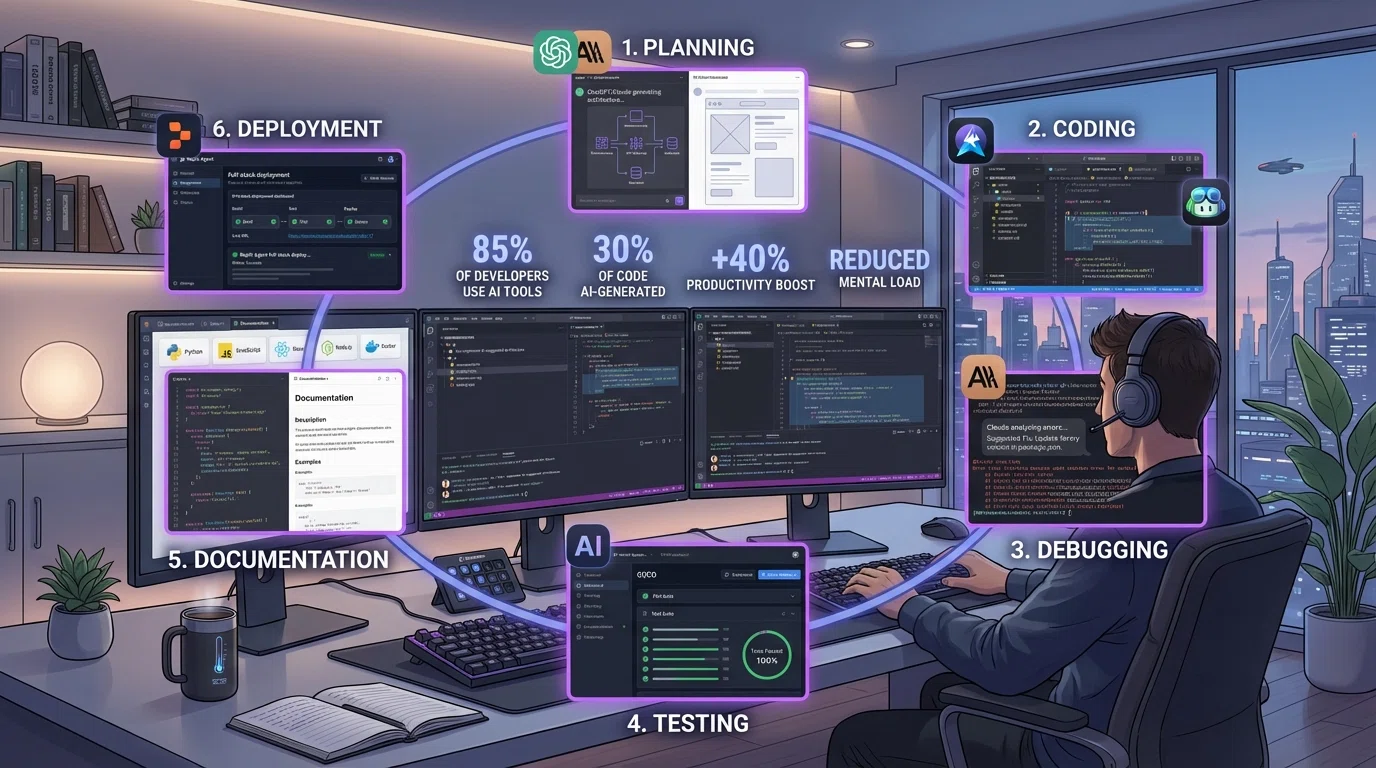
AI Coding Tools by Use Case
For Enterprise Teams:
- Primary: GitHub Copilot (enterprise governance, security, IP protection)
- Secondary: Claude (code reviews, architectural analysis)
- Organization: ChatGPT + ChatGPT Toolbox (team knowledge base)
For Startup Developers:
- Primary: Cursor (fast iteration, multi-file refactoring)
- Prototyping: Replit Agent (rapid full-stack development)
- Cost-Effective: ChatGPT free tier + Aider (open source)
For Solo Developers/Freelancers:
- Primary: GitHub Copilot Individual ($10/mo best value)
- General AI: ChatGPT + ChatGPT Toolbox (project organization)
- Specialized: Claude for debugging complex issues
For Students/Learners:
- Free Options: GitHub Copilot (verified student), ChatGPT, Claude free tier
- Learning: ChatGPT (best explanations and teaching)
- Practice: Replit Agent (deploy real projects)
For DevOps/Infrastructure:
- Primary: ChatGPT (Terraform, Kubernetes, Docker assistance)
- Automation: Aider (CLI-based, CI/CD integration)
- Debugging: Claude (analyze logs, understand infrastructure)
Learn how to organize your development workflow with our workflow automation guide.
Cost Considerations: Which Tools Are Worth Paying For?
As one developer notes, "developers now focus on 'which tool won't torch my credits?'" Cost-effectiveness has become a top consideration in 2026.
Best free/low-cost options:
- ChatGPT Free: GPT-5.2 Instant for general coding (rate-limited)
- Claude Free: Large context for code analysis (rate-limited)
- GitHub Copilot: Free for students/teachers/OSS maintainers
- Aider: Open-source, bring your own API key
- ChatGPT Toolbox Free: Core organization features
Best value paid options:
- GitHub Copilot Individual ($10/mo): Best price-to-value ratio for daily coding
- ChatGPT Go ($8/mo): 10x more messages for general coding assistance
- ChatGPT Toolbox Pro ($9.99/mo): Unlimited folders to organize coding projects
- Cursor Pro ($20/mo): Worth it if multi-file refactoring is frequent
Premium options for power users:
- GitHub Copilot Business ($39/user): Enterprise teams needing governance
- Cursor Business ($40/user): Teams doing complex collaborative development
- ChatGPT Plus ($20/mo): Unlimited GPT-5.2 Pro for intensive coding assistance
- Claude Pro ($20/mo): For developers analyzing massive codebases regularly
Productivity Gains: Real-World Impact
Developers using AI coding assistants report a 40% increase in productivity. But as experts note, the real advantage isn't speed alone—it's reduced mental load.
Actual productivity improvements reported:
- 40% faster task completion: Measured across various coding tasks
- Reduced cognitive load: AI handles boilerplate, you focus on design
- Better code quality: AI suggestions often follow best practices
- Faster onboarding: New developers get up to speed quicker
- Less context switching: Stay in IDE instead of searching documentation
Where AI coding tools excel:
- Boilerplate code generation
- Test case creation
- API integration
- Documentation generation
- Code refactoring
- Bug fixing and debugging
- Learning new frameworks
Where human judgment still dominates:
- Architectural decisions
- Product requirements
- Security considerations
- Performance optimization strategy
- User experience design
Integration with ChatGPT Toolbox for Developers
While IDE-integrated tools like Copilot and Cursor handle in-editor assistance, ChatGPT Toolbox solves a different critical problem: organizing your broader AI-assisted development workflow.
How developers use ChatGPT Toolbox:
1. Project Organization
Create folder hierarchies for each project: "Project X → Backend → API Design", "Project X → Frontend → Component Architecture", "Project X → DevOps → Deployment". Keep all architectural discussions, code reviews, and problem-solving organized by project.
2. Code Snippet Library
Export valuable code conversations to TXT or JSON for offline access. Build a personal library of solutions to common problems. Search your entire coding history to find that perfect solution from months ago.
3. Learning & Documentation
Save conversations where you learned new concepts or technologies. Create a "Learning" folder with subfolders: "React Hooks", "GraphQL", "Kubernetes", "System Design". Reference them when needed without re-asking ChatGPT.
4. Team Knowledge Sharing
Export important architectural discussions or debugging solutions. Share with teammates via bulk export. Maintain team standards documented in ChatGPT conversations.
5. Client/Project Separation
Freelance developers: separate conversations by client to prevent context bleeding. Keep client-specific code solutions organized and easily accessible.
Install ChatGPT Toolbox for free to transform ChatGPT from a simple chat interface into a professional development knowledge base.
Frequently Asked Questions
What are the best AI tools for developers in 2026?
The best AI tools for developers in 2026 are GitHub Copilot (best overall), Cursor (AI-native editor), Claude (large context understanding), Replit Agent (full-stack development), Windsurf, Aider (command-line), ChatGPT (general coding), and Cline. Each excels in different development workflows, with 85% of developers now using AI coding assistants regularly.
Is GitHub Copilot or Cursor better for developers?
GitHub Copilot is better for enterprise workflows, IDE integration, and developers within the GitHub ecosystem at $10-39/month. Cursor excels at multi-file refactoring, agentic workflows, and full codebase understanding at $20-40/month. Copilot has a 56.5% resolution rate vs Cursor's 51.7%, but Cursor is faster. Many teams use both in 2026.
What is the best free AI coding assistant?
The best free AI coding assistants are ChatGPT (free tier with GPT-5.2 Instant for general coding), Claude (free tier with large context for code analysis), and Aider (open-source command-line tool). GitHub Copilot offers a free tier for verified students and open-source maintainers.
How much does GitHub Copilot cost in 2026?
GitHub Copilot pricing in 2026: Individual $10/month or $100/year, Business $39/user/month (minimum 2 seats), Enterprise custom pricing with advanced security. Free for verified students, teachers, and maintainers of popular open-source projects.
What is Cursor AI and how is it different from VS Code?
Cursor is VS Code rebuilt with AI at the center of the editing experience. It keeps all VS Code features while adding AI that understands your entire repository and can safely apply changes across multiple files simultaneously. Composer mode allows autonomous, agent-like multi-file editing unavailable in standard VS Code.
Do developers actually use AI coding assistants?
Yes, approximately 85% of developers regularly use AI coding assistants as of 2026. AI now writes 30% of Microsoft's code and over 25% of Google's code. Developers report a 40% increase in productivity when using AI coding tools, with the real advantage being reduced mental load rather than just speed.
What AI tool is best for debugging code?
Claude is best for debugging complex code due to its large context window (200K+ tokens) and ability to explain reasoning clearly. It excels at understanding legacy code and tricky issues. GitHub Copilot and Cursor are also strong for debugging within IDE workflows, while ChatGPT is versatile for general debugging assistance.
Conclusion: Building Your AI Coding Stack
The AI coding landscape in 2026 offers specialized tools for every development workflow. The key isn't using every tool—it's building a focused stack that integrates seamlessly with how you already work.
Recommended AI coding stack for 2026:
Foundation (everyone needs):
- GitHub Copilot or Cursor (in-editor assistance)
- ChatGPT + ChatGPT Toolbox (general coding & organization)
Add specialized tools based on needs:
- Complex debugging: + Claude
- Rapid prototyping: + Replit Agent
- Terminal workflows: + Aider
Start with the foundation, then expand based on specific pain points. Don't pay for premium tiers until you've hit usage limits on free versions.
Install ChatGPT Toolbox for free to organize all your AI-assisted coding conversations by project, technology, and problem domain. Transform ChatGPT into a searchable development knowledge base with folder organization, bulk export, and advanced search.
Want to dive deeper? Explore our ChatGPT productivity guide, complete AI tools comparison, and how to use ChatGPT guide.
Last updated: March 16, 2026
