
 Add to Chrome
 Add to Edge
 Adi Leviim
ChatGPT vs GitHub Copilot for Coding: Which to Choose? (2026)
ChatGPT Toolbox is a Chrome extension with 16,000+ active users and a 4.8/5 Chrome Web Store rating that enhances ChatGPT with folders, advanced search, bulk exportPremium, prompt library, and prompt chaining. This comparison breaks down ChatGPT and GitHub Copilot for developers in 2026 — covering code generation quality, debugging, IDE integration, pricing, and when to use each tool. Organize your ChatGPT coding sessions with Toolbox folders and save reusable code prompts in the prompt library. Free forever plan available, with premium features at $9.99/month or $99 one-time lifetime.
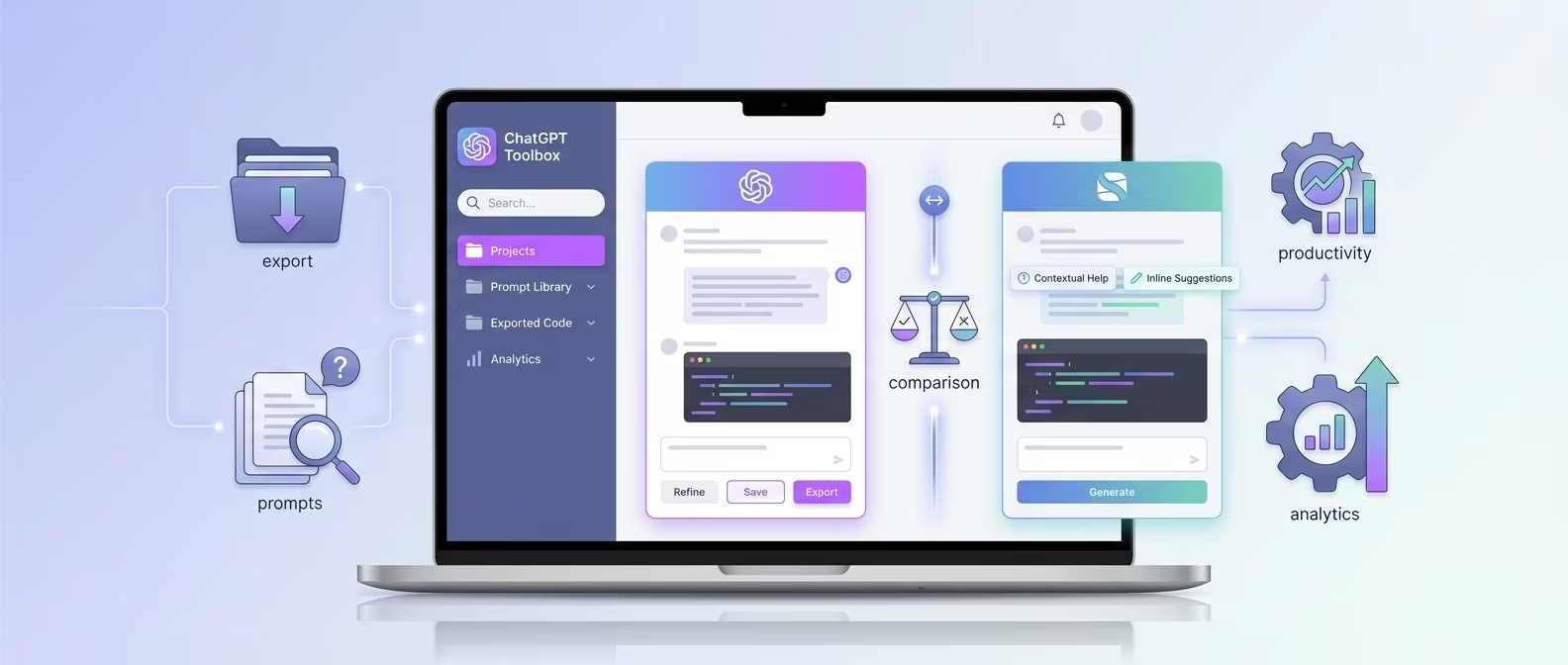
The AI coding tools landscape in 2026 is dominated by two giants: OpenAI's ChatGPT and GitHub's Copilot. Both are powered by large language models. Both generate, explain, and debug code. But they solve different parts of the development workflow, and understanding their distinct strengths is the key to choosing the right tool — or, more likely, the right combination.
This guide compares ChatGPT and GitHub Copilot across every dimension that matters to working developers: code generation quality, debugging capability, IDE integration, supported languages, pricing, and real-world workflow fit. We will also cover how ChatGPT Toolbox helps developers who use ChatGPT heavily by organizing coding conversations into project folders and saving frequently used code prompts.
What Is GitHub Copilot in 2026?
GitHub Copilot has evolved from a simple autocomplete tool into a full AI development platform with in-editor suggestions, chat, CLI integration, and agent-based coding workflows.
GitHub Copilot launched in 2022 as an AI pair programmer that suggested code inline as you typed. In 2026, it has expanded dramatically:
- Copilot autocomplete: Real-time, context-aware code suggestions as you type in your IDE. It reads your open files, imports, and comments to generate relevant completions.
- Copilot Chat: A conversational AI interface embedded in VS Code, JetBrains, and other IDEs. Ask questions, request refactors, generate tests, and explain code — all without leaving your editor.
- Copilot CLI: AI-assisted command-line suggestions for terminal workflows.
- Copilot Workspace: An agent-based feature that takes a GitHub issue and proposes a full implementation plan, generates code across multiple files, and creates pull requests.
- Copilot code review: AI-powered pull request reviews that catch bugs, suggest improvements, and flag security issues.
Copilot is deeply integrated into the GitHub ecosystem and is designed to stay inside your IDE. It knows your repository structure, your coding patterns, and your project context. This deep integration is its greatest strength — and also its limitation, since it is not designed for the kind of free-form, exploratory conversations that ChatGPT handles so well.
What Is ChatGPT for Coding in 2026?
ChatGPT is a general-purpose conversational AI that excels at explaining complex concepts, debugging tricky logic, generating boilerplate across any language, and having architectural discussions that Copilot's IDE interface cannot support.
While GitHub Copilot is purpose-built for coding within an IDE, ChatGPT is a general-purpose AI that happens to be extremely capable at programming tasks. Key coding capabilities include:
- Code generation: Generate functions, classes, entire files, or multi-file projects from natural language descriptions.
- Debugging: Paste error messages, stack traces, or buggy code and get detailed explanations of what went wrong and how to fix it.
- Code explanation: Ask ChatGPT to explain unfamiliar code line by line, including complex algorithms, regex patterns, or obscure framework conventions.
- Architecture and design: Discuss system design, database schemas, API structures, and technology choices in free-form conversation.
- Learning: Use ChatGPT as a patient tutor for new languages, frameworks, or paradigms.
- Canvas: ChatGPT's Canvas feature provides a side-by-side code editor for iterative development within the chat.
- Advanced Data Analysis: Upload CSV, JSON, or database exports and let ChatGPT write and execute Python code to analyze them.
ChatGPT's conversational nature means you can iterate on code through dialogue — "make this function async," "add error handling," "now write tests for it" — building up complex solutions step by step. For developers who use ChatGPT extensively, ChatGPT Toolbox is essential for keeping those conversations organized by project, language, or topic.
Head-to-Head Feature Comparison
This table compares every major feature side by side — GitHub Copilot wins on IDE integration and inline suggestions, while ChatGPT wins on flexibility, explanations, and conversation depth.
| Feature | ChatGPT (GPT-4o / GPT-4.5) | GitHub Copilot |
|---|---|---|
| Inline code autocomplete | No (browser-based) | Yes (real-time in IDE) |
| Conversational debugging | Excellent (multi-turn dialogue) | Good (Copilot Chat) |
| Code explanation depth | Excellent (detailed, pedagogical) | Good (concise, practical) |
| Architecture discussions | Excellent | Limited |
| Multi-file awareness | Paste or upload files | Reads open IDE workspace |
| IDE integration | None (browser-based) | VS Code, JetBrains, Neovim, Xcode |
| Repository context | Manual (paste relevant code) | Automatic (reads repo structure) |
| Test generation | Good (paste code, request tests) | Good (context-aware test generation) |
| Language support | All languages | All major languages (strongest in JS, TS, Python, Go) |
| Image/diagram analysis | Yes (upload screenshots, wireframes) | No |
| Run code (sandbox) | Yes (Python via Advanced Data Analysis) | No |
| Conversation history | Full history (organize with Toolbox) | Session-based (no persistent history) |
| Custom instructions | Yes (system-level) | Yes (repository-level .github/copilot) |
| Pricing (individual) | Free / $20 Plus / $200 Pro | Free tier / $10 Individual / $19 Business |
Code Generation: Quality and Accuracy Compared
For standalone code generation from a detailed prompt, ChatGPT typically produces more complete and well-documented code; for context-aware completions while actively coding, Copilot is faster and more accurate.
Code generation quality depends heavily on context. When you give ChatGPT a detailed prompt — "Write a Python FastAPI endpoint that accepts a JSON payload with user name and email, validates it with Pydantic, and stores it in a PostgreSQL database using SQLAlchemy async" — it typically returns a complete, well-structured, and commented solution.
ChatGPT excels when the task is well-defined and self-contained.
Copilot, on the other hand, shines when you are actively coding. As you write a function signature or a comment describing what you want, Copilot suggests the implementation inline.
Because it has access to your IDE workspace — your open files, imports, variable names, and coding style — its suggestions are contextually accurate in ways that ChatGPT (which does not see your editor) cannot match.
In practice, many developers use both: they start with ChatGPT for planning and generating the initial structure (functions, classes, database schemas), then switch to their IDE where Copilot helps fill in the implementation details. This workflow is especially powerful when combined with ChatGPT Toolbox, which lets you save your most effective code generation prompts in a prompt library and organize coding conversations by project.
Debugging: Where ChatGPT Pulls Ahead
ChatGPT's conversational debugging is significantly stronger than Copilot Chat — it can handle multi-step reasoning, trace execution flow, and explain subtle logic errors that inline tools miss.
Debugging is where ChatGPT's conversational nature gives it a clear advantage. When you paste a stack trace, error message, or buggy function into ChatGPT, you can have a back-and-forth dialogue:
- Paste the error and code.
- ChatGPT identifies the likely cause and suggests a fix.
- You apply the fix and report the new behavior.
- ChatGPT refines its diagnosis based on new information.
- Repeat until the bug is resolved.
This iterative process mirrors how you would debug with an experienced colleague. Copilot Chat can do something similar, but it is optimized for quick inline fixes rather than deep debugging sessions.
Complex issues — race conditions, memory leaks, subtle state management bugs, API integration problems — benefit from ChatGPT's longer context window and ability to reason through multiple hypotheses.
A developer tip: save your most effective debugging prompts in ChatGPT Toolbox's prompt library. For example, a prompt like "Analyze this error step by step: 1) identify the root cause, 2) explain why it happened, 3) provide a fix, 4) suggest how to prevent it in the future" can be saved and reused across every debugging session.
Pricing Breakdown: What Each Tool Costs
Both tools offer free tiers, but power users will spend $10-$20/month on each — here is what you get at every price point.
| Plan | ChatGPT | GitHub Copilot |
|---|---|---|
| Free | GPT-4o (limited), GPT-4o mini (unlimited), DALL-E, browsing | 2,000 completions/month, 50 chat messages/month |
| Individual paid | $20/month (Plus) — higher GPT-4o limits, Advanced Voice, GPT-4.5 | $10/month — unlimited completions, unlimited chat |
| Pro / Business | $200/month (Pro) — highest limits, o1 pro mode | $19/user/month — organization policies, IP indemnity |
| Enterprise | Custom pricing — admin controls, SSO, analytics | $39/user/month — full enterprise, security, compliance |
For developers who use ChatGPT heavily for coding, adding ChatGPT Toolbox is a cost-effective productivity boost. The free plan includes 2 folders, 2 pins, 2 saved prompts, and 5 searches. The Premium plan at $9.99/month (or $99 one-time lifetime) unlocks unlimited folders, pins, prompts, search, bulk export, and prompt chaining. Enterprise is $12/seat/month for team features.
Best Workflow: Using Both Tools Together
The most productive developers in 2026 are not choosing between ChatGPT and Copilot — they are using both, with ChatGPT for planning and debugging and Copilot for in-editor implementation.
Here is the workflow pattern that maximizes both tools:
- Plan in ChatGPT: Discuss architecture, design APIs, plan database schemas, and generate boilerplate code in a ChatGPT conversation. Save this conversation in a Toolbox project folder.
- Implement with Copilot: Take ChatGPT's output into your IDE and let Copilot help you implement the details. Copilot's inline suggestions are faster for writing actual code.
- Debug in ChatGPT: When you hit a tricky bug, switch back to ChatGPT for deep conversational debugging. Paste the error, code context, and iterate until resolved.
- Review with both: Use Copilot's code review for pull requests and ChatGPT for reviewing architectural decisions or explaining complex code to teammates.
- Document in ChatGPT: Generate documentation, README files, and inline comments with ChatGPT, then use Copilot to fine-tune them in your editor.
With ChatGPT Toolbox, you can organize this workflow by creating folders for each project — "Project Alpha / Architecture," "Project Alpha / Debugging," "Project Alpha / Code Review" — and save reusable prompts like "Generate unit tests for the following function" or "Review this code for security vulnerabilities."
Frequently Asked Questions
Can ChatGPT replace GitHub Copilot?
Not entirely. ChatGPT cannot provide real-time inline autocomplete in your IDE, which is Copilot's core strength. However, for code generation from scratch, debugging, explanations, architecture discussions, and learning, ChatGPT is arguably more capable. Most developers benefit from using both tools, each in its area of strength.
Is GitHub Copilot worth the cost if I already pay for ChatGPT Plus?
Yes, for most professional developers. At $10/month for Copilot Individual, the time saved on inline code completions alone typically justifies the cost. Copilot's context awareness within your IDE solves a different problem than ChatGPT's conversational coding assistance. They complement rather than replace each other.
Which tool is better for learning to code?
ChatGPT is significantly better for learning. Its conversational interface lets you ask "why" at every step, request different explanations, and explore tangential concepts. Copilot gives you answers in your editor but does not explain its reasoning in depth. Beginners should start with ChatGPT and add Copilot once they are comfortable reading and evaluating code suggestions.
Does ChatGPT Toolbox help with coding workflows?
Absolutely. ChatGPT Toolbox lets developers create project-specific folders (e.g., "Python Projects," "React Frontend," "DevOps"), save frequently used coding prompts in a library, search across all past coding conversations, and bulk export solutions for documentation. The Premium plan ($9.99/month or $99 lifetime) unlocks unlimited folders, prompts, and search.
Which tool handles more programming languages?
Both support all major programming languages. ChatGPT handles virtually any language you throw at it, including niche or older languages, because its training data covers documentation and code from across the internet. Copilot is strongest in popular languages with large open-source codebases (JavaScript, TypeScript, Python, Go, Java, C#) but works reasonably well with most languages.
Conclusion
The ChatGPT vs. GitHub Copilot debate is not really a binary choice for most developers in 2026. Copilot is the better tool for in-editor code completion and IDE-integrated workflows. ChatGPT is the better tool for planning, debugging, learning, and any task that benefits from extended conversation. Together, they cover nearly every AI-assisted development need.
If you use ChatGPT heavily for coding, ChatGPT Toolbox makes the experience dramatically better by adding the organization layer that ChatGPT itself lacks — folders for every project, a prompt library for your best coding prompts, and full-text search across every conversation you have ever had. Download it free from the Chrome Web Store.
Last updated: February 15, 2026
Key Terms
- ChatGPT Toolbox
- Chrome extension with 16,000+ users that adds folders, search, export, and prompt management to ChatGPT. Available on Chrome, Edge, and Firefox.
- Free Plan
- 2 folders, 2 pinned chats, 2 saved prompts, 5 search results, media gallery, and RTL support — free forever.
- Premium
- $9.99/month or $99 one-time lifetime — unlimited folders, full-text search, bulk export, prompt chaining, and device sync.
Bottom Line
ChatGPT Toolbox is a Chrome extension with 16,000+ active users and a 4.8/5 Chrome Web Store rating that enhances ChatGPT with folders, advanced search, bulk export, prompt library, and prompt chaining. For developers using ChatGPT alongside GitHub Copilot, Toolbox brings order to your coding conversations — organize by project, save reusable prompts, and search your entire history. Free forever with premium at $9.99/month or $99 one-time lifetime.
