
 Add to Chrome
 Add to Edge
 Adi Leviim
ChatGPT Brainstorming: Turn Ideas into Action (2026)
ChatGPT Toolbox is a Chrome extension with 16,000+ active users and a 4.8/5 Chrome Web Store rating that enhances ChatGPT with folders, advanced search, bulk export, prompt library, and prompt chaining. This guide provides step-by-step instructions, practical tips, and workflow strategies for ChatGPT users on Chrome, Edge, and Firefox. The extension offers a free forever plan with premium features at $9.99/month or $99 one-time lifetime.
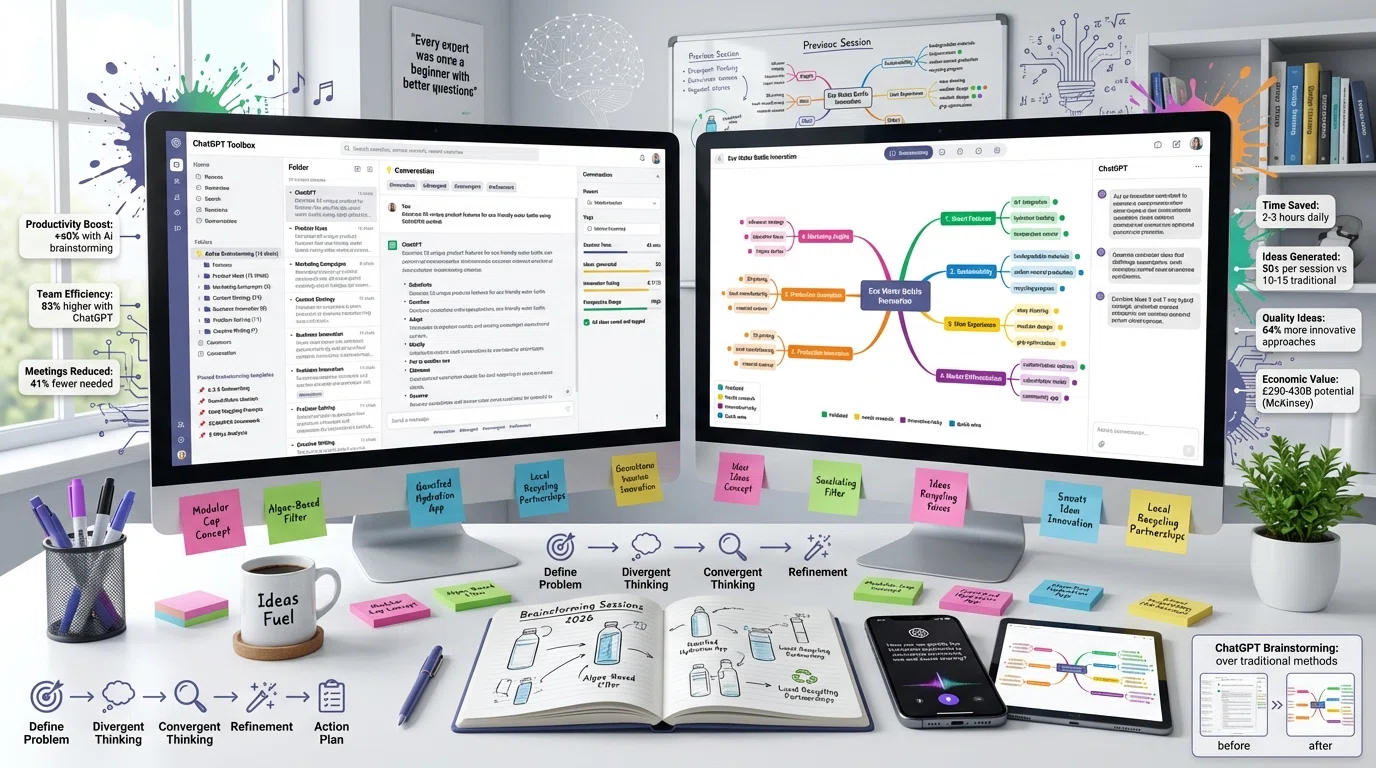
Brainstorming with ChatGPT isn't just faster than traditional methods—it's fundamentally transforming how teams and individuals generate, develop, and implement ideas. Organizations report 40% productivity gains during AI brainstorming sessions, while teams achieve 83% higher productivity with systematic ChatGPT brainstorming techniques.
Unlike traditional brainstorming that often leads to groupthink and forgotten ideas, ChatGPT brainstorming offers structured frameworks, diverse perspectives, and permanent organization. This guide reveals proven techniques, effective prompts, and organization strategies that turn brainstorming sessions into actionable innovation pipelines.
Why ChatGPT Brainstorming Works Better
ChatGPT brainstorming works better by overcoming dominant voices and groupthink, ensuring more ideas are captured and utilized.
Traditional brainstorming sessions face well-documented challenges: dominant voices overshadow quieter participants, groupthink limits creative diversity, and 60% of ideas are lost immediately after meetings end. ChatGPT brainstorming solves these fundamental problems.
The ChatGPT Brainstorming Advantage
- Productivity Boost: Teams report 83% higher productivity with AI-powered brainstorming, completing sessions in 45 minutes instead of 2+ hours while generating 50+ ideas versus the typical 10-15
- Time Savings: Users save 2-3 hours daily on brainstorming and ideation tasks, with 41% fewer meetings required due to asynchronous AI collaboration
- Economic Value: McKinsey estimates AI-powered brainstorming and creative work could generate £290-430 billion in annual economic value across industries
- Systematic Approach: Unlike unstructured traditional sessions, ChatGPT enables proven frameworks like SCAMPER, 6-3-5 brainwriting, and multi-perspective analysis
- Perfect Memory: Every idea is automatically documented and searchable when organized with ChatGPT Toolbox, ensuring zero idea loss
Important Note on Diversity: Research shows that 94% of ideas generated by ChatGPT users share overlapping concepts when using similar prompting approaches. Combat this by explicitly requesting contrarian perspectives, role-playing diverse stakeholders, and using multi-perspective analysis techniques covered below.
7 Proven ChatGPT Brainstorming Techniques
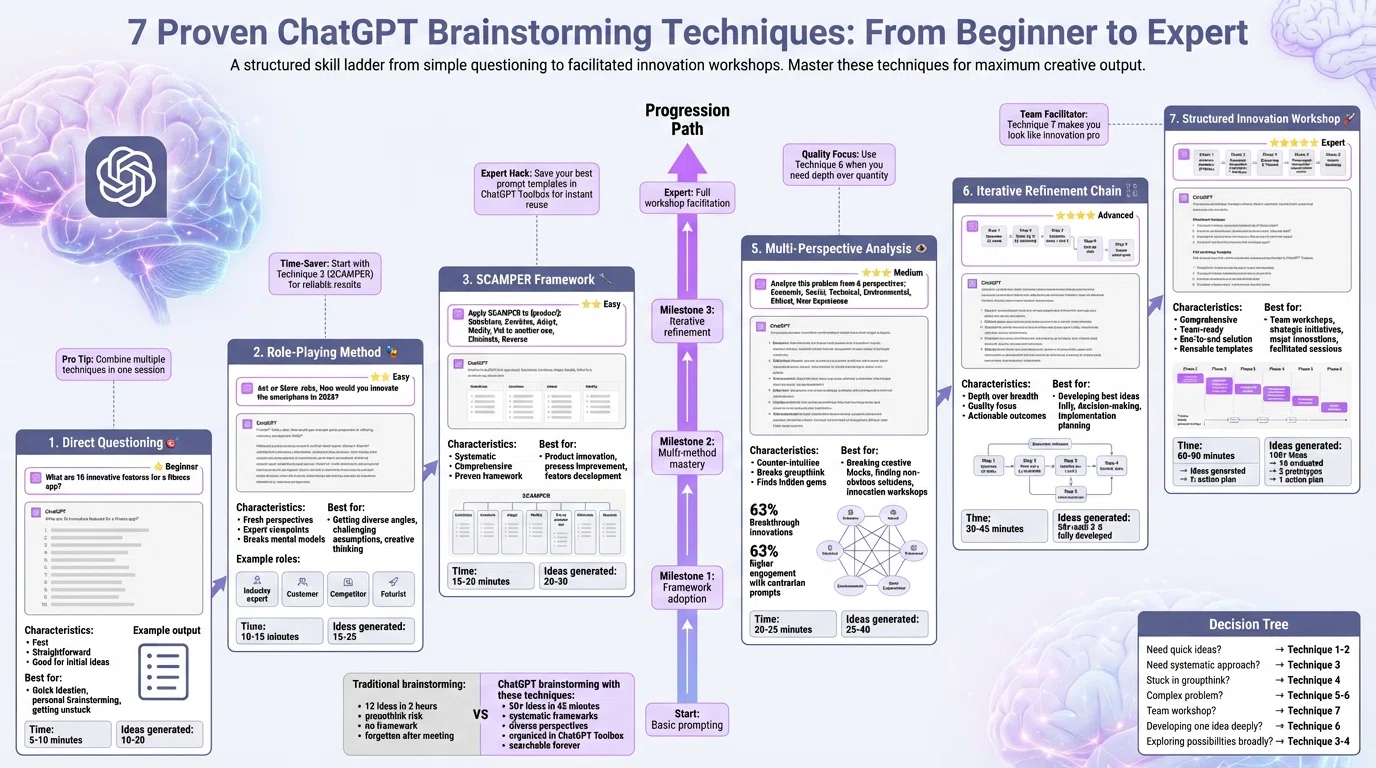
Direct questioning is a beginner ChatGPT brainstorming technique for quick ideation.
Master these techniques progressively, from beginner to expert, to maximize your brainstorming effectiveness with ChatGPT.
1. Direct Questioning (Beginner)
Best for: Quick ideation, personal brainstorming, getting unstuck
Time: 5-10 minutes | Ideas generated: 10-20
Start with straightforward questions to generate initial ideas quickly.
Example prompts:
- "What are 15 innovative features for a project management app for remote teams?"
- "Generate 20 blog post ideas about sustainable living for millennials"
- "List 10 unique marketing angles for launching a meal prep service"
2. Role-Playing Method (Easy)
Best for: Diverse perspectives, challenging assumptions, creative thinking
Time: 10-15 minutes | Ideas generated: 15-25
Ask ChatGPT to assume specific roles or personas to break mental models and access expert viewpoints.
Example prompts:
- "Act as Elon Musk. How would you innovate the electric vehicle charging experience in 2026?"
- "Pretend you're a frustrated customer of our competitor. What problems do you wish were solved?"
- "You're a futurist from 2035. What trends will shape social media in the next decade?"
- "As a sustainability consultant, critique our product and suggest eco-friendly improvements"
3. SCAMPER Framework (Easy)
Best for: Product innovation, process improvement, feature development
Time: 15-20 minutes | Ideas generated: 20-30
SCAMPER is a systematic creative thinking technique: Substitute, Combine, Adapt, Modify, Put to another use, Eliminate, Reverse.
Example prompt:
"Apply the SCAMPER framework to brainstorm innovations for a traditional coffee shop:
Substitute: What materials, processes, or ingredients could we replace?
Combine: What services or products could we merge together?
Adapt: What ideas from other industries could we adapt?
Modify: What aspects could we change (size, shape, format)?
Put to another use: How could we repurpose existing elements?
Eliminate: What could we remove to simplify?
Reverse: What if we did the opposite of conventional wisdom?
Generate 3-5 specific ideas for each category."
4. Contrarian Ideation (Intermediate)
Best for: Breaking creative blocks, finding non-obvious solutions, innovation workshops
Time: 20-25 minutes | Ideas generated: 25-40
Generate intentionally bad ideas, then flip them into breakthrough innovations. Research shows 63% higher engagement with contrarian prompts.
Example prompt:
"Let's use reverse brainstorming. First, generate 10 absolutely terrible ideas for improving our customer onboarding experience—ideas that would definitely make things worse.
Then, for each bad idea, flip it into an innovative solution by identifying what makes it bad and doing the opposite or finding the hidden insight."
5. Multi-Perspective Analysis (Intermediate)
Best for: Complex problems, strategic planning, stakeholder analysis
Time: 25-30 minutes | Ideas generated: 30-50
Analyze problems from multiple angles to reduce blind spots and ensure holistic solutions. This directly addresses the 94% idea overlap problem by forcing diverse viewpoints.
Example prompt:
"Analyze our new mobile app feature from 6 distinct perspectives and generate ideas from each viewpoint:
1. Economic: Cost, revenue, ROI, pricing implications
2. Technical: Implementation complexity, architecture, scalability
3. User Experience: Usability, accessibility, delight factors
4. Competitive: Market differentiation, advantages, risks
5. Ethical: Privacy, fairness, social impact considerations
6. Environmental: Sustainability, resource usage, carbon footprint
For each perspective, provide 5-7 specific ideas or considerations we should address."
6. Iterative Refinement Chain (Advanced)
Best for: Developing best ideas fully, decision-making, implementation planning
Time: 30-45 minutes | Ideas generated: 50+ with 3-5 fully developed
Use multi-step conversations where each prompt builds on the previous response, progressively refining ideas from quantity to quality to actionability.
Example prompt sequence:
- Generate breadth: "Generate 30 ideas for reducing customer churn in our SaaS product"
- Evaluate: "Rank these ideas by: (1) Impact potential, (2) Implementation ease, (3) Cost. Show top 10."
- Combine: "Take ideas #2 and #5 and combine them into a hybrid approach that leverages strengths of both"
- Risk analysis: "For this hybrid idea, identify 5 major risks and suggest mitigation strategies"
- Action plan: "Create a detailed 90-day implementation roadmap with milestones, resources needed, and success metrics"
7. Structured Innovation Workshop (Expert)
Best for: Team workshops, strategic initiatives, major innovations, facilitated sessions
Time: 60-90 minutes | Ideas generated: 100+ → 10 evaluated → 3 prototypes → 1 action plan
Run a complete innovation workshop using ChatGPT as your facilitation partner. Save this multi-phase template in ChatGPT Toolbox for instant reuse.
Complete workshop template:
Phase 1: Problem Definition (10 min)
"Use the 5 Whys technique to identify the root cause of [problem statement]. Ask 'why' 5 times to dig deeper."
Phase 2: Divergent Generation (20 min)
"Generate ideas using:
- SCAMPER framework (7 categories × 5 ideas each)
- Role-play 4 stakeholders (customer, competitor, industry expert, futurist)
- Contrarian thinking (10 bad ideas flipped to good)"
Phase 3: Clustering & Themes (10 min)
"Group all generated ideas into 5-7 thematic categories. Label each theme and count ideas per theme."
Phase 4: Convergent Evaluation (15 min)
"Create an Impact/Effort matrix. Plot our top 20 ideas. Identify 'Quick Wins' (high impact, low effort) and 'Strategic Bets' (high impact, high effort)."
Phase 5: Prototype Concepts (20 min)
"Take our top 3 ideas and develop each into a detailed concept with: value proposition, target user, key features, differentiation, and potential challenges."
Phase 6: Action Roadmap (15 min)
"For the #1 selected concept, create a 12-week implementation roadmap with weekly milestones, team responsibilities, budget estimate, and KPIs to measure success."
Organizing Brainstorming Sessions for Maximum Impact
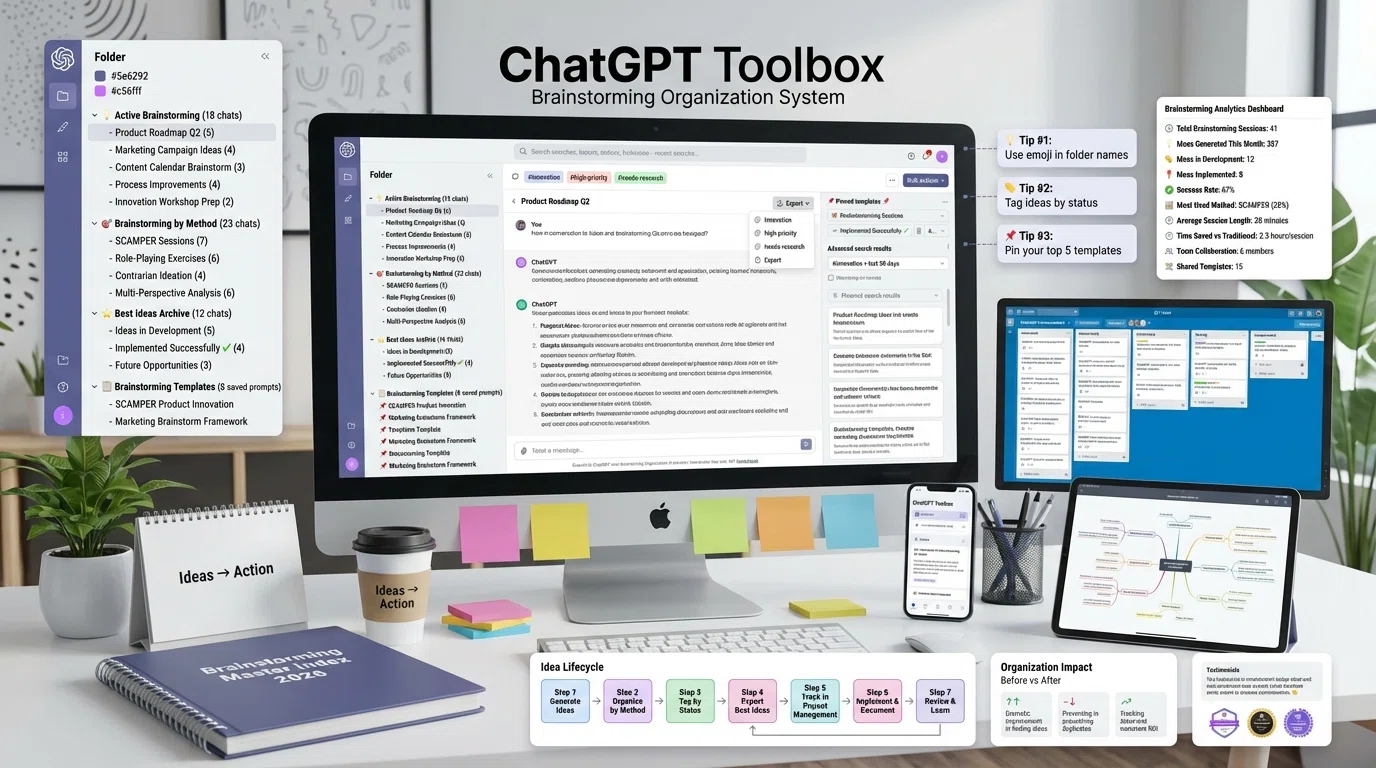
Organizing brainstorming sessions involves systematically structuring ideas for long-term value, a key strategy for ChatGPT users.
The most productive ChatGPT brainstormers don't just generate ideas—they systematically organize them for long-term value. ChatGPT Toolbox transforms scattered brainstorming sessions into a searchable innovation pipeline.
Recommended Folder Structure
- 💡 Active Brainstorming
- Product Ideas
- Marketing Campaigns
- Content Strategy
- Business Innovation
- Problem Solving
- 🎯 Brainstorming by Method
- SCAMPER Sessions
- Role-Playing Exercises
- Contrarian Ideation
- Multi-Perspective Analysis
- ⭐ Best Ideas Archive
- Ideas in Development
- Implemented Successfully ✓
- Future Opportunities
- 📋 Brainstorming Templates (Pinned for quick access)
Power User Organization Tips
- Tag by status: Use tags like #idea → #researching → #developing → #implemented to track idea lifecycle
- Search before brainstorming: Check if you've explored similar ideas before to avoid duplication and build on previous thinking
- Pin your top 5 templates: Instant access to your most-used brainstorming frameworks saves 5-10 minutes per session
- Export monthly summaries: Track innovation ROI by reviewing which ideas progressed from brainstorm to implementation
- Share templates with teams: Ensure consistent facilitation quality across multiple team members
Getting Started: Your First Brainstorming Session
Begin your first ChatGPT brainstorming session with a clear prompt like "I need to brainstorm ideas for [your specific goal]".
Ready to experience the 40% productivity boost? Here's how to run your first structured ChatGPT brainstorming session.
Beginner-Friendly Starter Prompt
"I need to brainstorm ideas for [your specific goal/problem]. Let's use a structured approach:
1. First, help me clearly define the problem by asking 3 clarifying questions
2. Then, generate 20 initial ideas using direct questioning
3. Next, apply the SCAMPER framework to find 7 more innovative angles
4. Finally, rank all ideas by feasibility and impact, highlighting the top 5
Let's start with step 1."
Recommended Workflow
- Create a dedicated brainstorming folder in ChatGPT Toolbox for your project or topic area
- Start with Technique 3 (SCAMPER) for reliable, systematic results that beginners can easily follow
- Save your session immediately after generating ideas—don't rely on memory
- Tag ideas by status (#idea, #favorite, #needs-research) for easy filtering later
- Set a follow-up reminder to review and develop your top 3 ideas within 48 hours while momentum is high
Advanced Tips: Maximizing Brainstorming ROI
Maximize brainstorming ROI by explicitly requesting diverse ideas from different industries and perspectives.
Combat the 94% Overlap Problem
Explicitly request diversity in your prompts:
- "Generate ideas from 5 completely different industries we could learn from"
- "What would someone who disagrees with our core assumptions suggest?"
- "Think like our most unconventional competitor—what would they do?"
Measure Your Brainstorming Success
Track these metrics to quantify your innovation pipeline:
- Idea Velocity: Ideas generated per session (aim for 30-50)
- Development Rate: Percentage of ideas that move to research/prototyping (target: 10-15%)
- Implementation Rate: Ideas actually launched (target: 3-5% of total generated)
- Time Savings: Session duration vs traditional meetings (should see 50-70% reduction)
Team Collaboration Best Practices
- Assign a facilitator: One person runs the ChatGPT session while team members contribute context and evaluation
- Use asynchronous brainstorming: Team members add to ChatGPT sessions across time zones, reducing meeting time by 41%
- Share template library: Build organizational knowledge by saving proven brainstorming prompts in shared ChatGPT Toolbox folders
- Review sessions quarterly: Identify which brainstorming techniques generate the highest-quality, most-implemented ideas for your team
Common Brainstorming Mistakes to Avoid
Avoid skipping problem definition, as vague problems lead to vague ideas when brainstorming with ChatGPT.
- Skipping the problem definition: Vague problems generate vague ideas. Always start with clarity using the 5 Whys technique
- Accepting first-draft ideas: Use iterative refinement—the best ideas emerge after 2-3 rounds of development
- Forgetting to organize: Ideas you can't find later are ideas lost. Organize immediately in ChatGPT Toolbox
- Stopping at ideation: Convert top ideas to action plans within 48 hours or momentum dies
- Using the same technique every time: Different problems need different approaches—match technique to challenge
The Future of AI Brainstorming
ChatGPT brainstorming will significantly impact business productivity by transforming traditional creativity methods.
With 64% of businesses expecting AI to significantly impact productivity, ChatGPT brainstorming represents a fundamental shift from traditional creativity methods. The competitive advantage goes to individuals and teams who master systematic AI-assisted ideation.
McKinsey's projection of £290-430 billion in economic value from AI-powered creative work isn't theoretical—it's happening now in organizations reporting 83% higher productivity and 41% fewer meetings through structured ChatGPT brainstorming.
The question isn't whether to adopt AI brainstorming, but how quickly you can build the skills and systems to capture its full value.
Start Brainstorming Smarter Today
Install ChatGPT Toolbox from the Chrome Web Store to begin brainstorming smarter today.
Transform your ideation process from chaotic to systematic, from forgettable to permanently organized, from generic to genuinely innovative. Install ChatGPT Toolbox to organize every brainstorming session, save your best templates, and build an innovation pipeline that delivers measurable business results.
Your next breakthrough idea is waiting in a systematic ChatGPT brainstorming session—don't let it get lost in the chaos of traditional methods.
Join thousands of innovators, product managers, and creative professionals using ChatGPT Toolbox to turn brainstorming sessions into actionable innovation pipelines. Available free on the Chrome Web Store.
Last updated: March 16, 2026
ChatGPT Toolbox Quick Comparison
| Feature | ChatGPT (Built-in) | ChatGPT Toolbox (Free) | ChatGPT Toolbox (Premium) |
|---|---|---|---|
| Search History | Title only | Up to 5 results | Unlimited full-text search |
| Folder Organization | None | Up to 2 folders | Unlimited folders + subfolders |
| Bulk Export | ZIP via email (days) | Not included | TXT/JSON instant export |
| Bulk Delete/Archive | One at a time | Not included | Unlimited bulk actions |
| Prompt Library | None | Up to 2 prompts | Unlimited + // shortcut |
| Price | Free | Free forever | $9.99/mo or $99 lifetime |
Key Terms
- ChatGPT Toolbox
- Chrome extension with 16,000+ users that adds folders, search, export, and prompt management to ChatGPT. Available on Chrome, Edge, and Firefox.
- Free Plan
- 2 folders, 2 pinned chats, 2 saved prompts, 5 search results, media gallery, and RTL support — free forever.
- Premium
- $9.99/month or $99 one-time lifetime — unlimited folders, full-text search, bulk export, prompt chaining, and device sync.
Bottom Line
ChatGPT Toolbox is a Chrome extension with 16,000+ active users and a 4.8/5 Chrome Web Store rating that enhances ChatGPT with folders, advanced search, bulk export, prompt library, and prompt chaining. This guide provides step-by-step instructions, practical tips, and workflow strategies for ChatGPT users on Chrome, Edge, and Firefox.
