
 Add to Chrome
 Add to Edge
 Adi Leviim
200+ ChatGPT Prompts for Business: Save 10+ Hours/Week (2026)
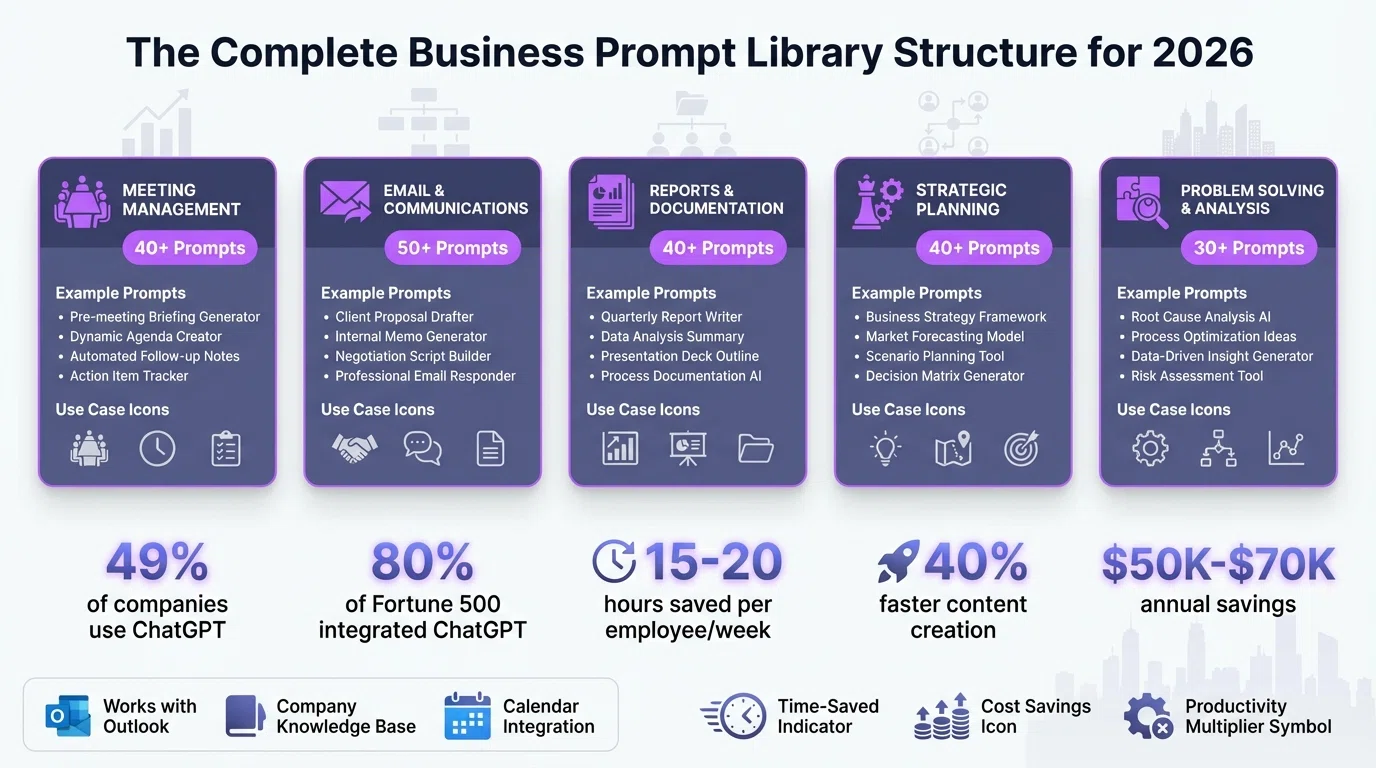
Business professionals are saving 15-20 hours per week using ChatGPT for meetings, emails, reports, and strategic planning. With 49% of companies now using ChatGPT and 80% of Fortune 500 enterprises integrating AI into their workflows, having a comprehensive library of business prompts is no longer optional—it's essential for staying competitive in 2026.
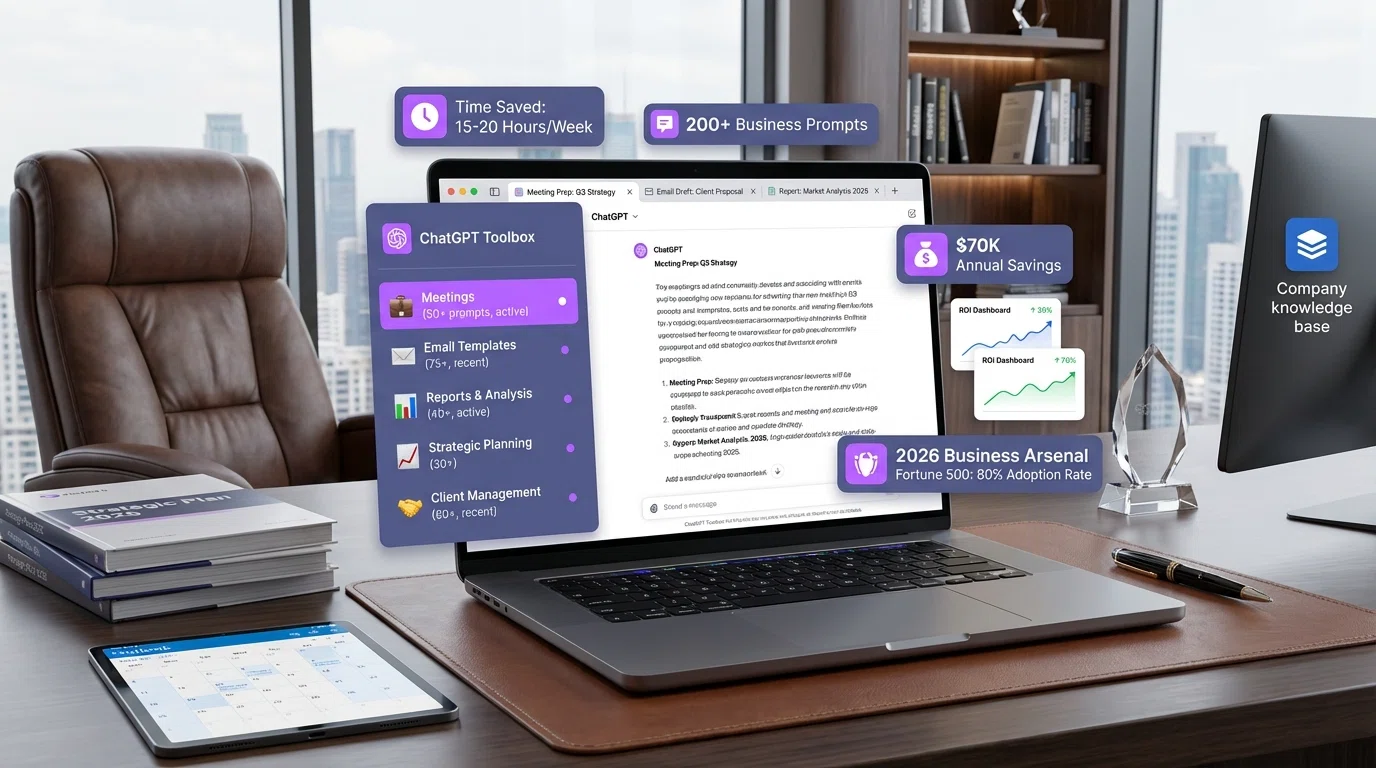 This complete guide provides 200+ copy-paste ready business prompts organized by category, proven strategies for maximizing productivity, and actionable tips for saving your prompts with ChatGPT Toolbox for instant access. Whether you're preparing for meetings, drafting client emails, writing reports, or developing strategic plans, these prompts will transform how you work.
Key Takeaways
- Save 15-20 hours per week with structured business prompts for meetings, emails, reports, and planning
- 49% of companies use ChatGPT; 80% of Fortune 500 have integrated AI workflows
- $50K-$70K annual savings reported by 25% of businesses using AI (11% save over $100K)
- 40% faster content creation and 30-40% operational cost reduction with AI automation
- New 2026 features: Outlook integration, Company Knowledge base, and calendar connectors
- ChatGPT Toolbox lets you save, organize, and access your business prompts instantly
Why Business Professionals Need a ChatGPT Prompt Library in 2026
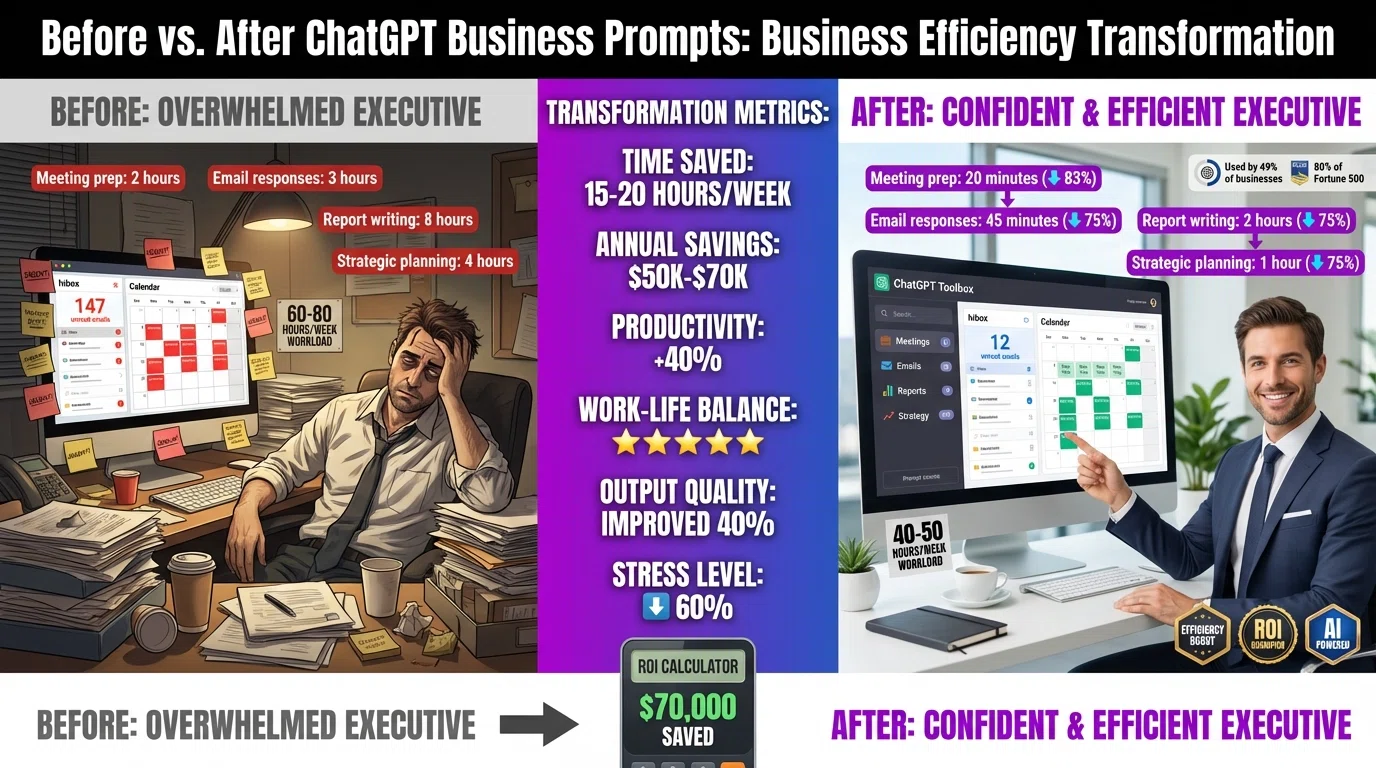
According to Knack research, companies using ChatGPT are experiencing 40% faster content creation and 30-40% reduction in operational costs. The key to these impressive results? Having the right prompts ready when you need them.
Here's why a business prompt library is essential:
- Time Savings: Employees save 15-20 hours per week by using pre-built prompts instead of writing requests from scratch
- Consistency: Standardized prompts ensure consistent quality across teams and departments
- Best Practices: Curated prompts incorporate proven structures that deliver better results
- Onboarding: New team members can immediately access tested prompts without a learning curve
- ROI: 25% of businesses report $50K-$70K annual savings, with 11% saving over $100K
The most efficient business professionals use ChatGPT Toolbox to save their best-performing prompts in organized folders (Meetings, Emails, Reports, Strategy) for instant access. This simple workflow change can save 2-3 hours per week just from not recreating prompts.
1. Meeting Management Prompts (40+ Prompts)
Meetings consume 15-20% of business professionals' time. These prompts help you prepare efficiently, run effective meetings, and follow up with clear action items—saving 5-8 hours per week.
Pre-Meeting Preparation
Create a detailed meeting agenda for [MEETING TYPE] with [NUMBER] participants. The meeting objective is [OBJECTIVE]. Include: 1) Time allocations for each topic, 2) Discussion questions, 3) Decision points, 4) Attendee preparation requirements, 5) Success metrics. Keep the meeting to [DURATION] minutes total.
I'm meeting with [STAKEHOLDER NAME/ROLE] about [TOPIC]. Summarize the key points I should cover, potential concerns they might raise, data/metrics to prepare, and recommended approach based on their priorities and communication style.
I have a meeting about [TOPIC] in [TIMEFRAME]. Create a research brief including: 1) Key background information, 2) Recent industry developments, 3) Competitor approaches, 4) Relevant data points, 5) Strategic considerations, 6) Recommended talking points.
Create a comprehensive preparation checklist for my [MEETING TYPE] with [ATTENDEES] about [TOPIC]. Include: materials to prepare, data to gather, questions to anticipate, technology to test, follow-up items to ready, and time-saving preparation tips.
During Meeting Support
Create a structured meeting notes template for [MEETING TYPE] that includes: 1) Attendees and roles, 2) Discussion topics with timestamps, 3) Decisions made, 4) Action items with owners and deadlines, 5) Parking lot items, 6) Next steps. Format for easy distribution.
We need to make a decision about [DECISION TOPIC]. Help facilitate by: 1) Clarifying the decision criteria, 2) Listing pros/cons for each option, 3) Identifying risks and mitigation strategies, 4) Recommending a decision framework, 5) Suggesting next steps based on the decision.
Post-Meeting Follow-Up
Write a concise meeting summary email for [MEETING TYPE] that covers: 1) Key decisions made, 2) Action items with owners and deadlines, 3) Outstanding questions, 4) Next meeting date/time if applicable, 5) Links to relevant documents. Keep it under 200 words for busy executives.
Convert these meeting notes into a structured action item tracker: [PASTE NOTES]. Create a table with columns: Action Item, Owner, Deadline, Priority (High/Medium/Low), Status, and Dependencies. Include follow-up reminders schedule.
Analyze this meeting outcome: [DESCRIBE MEETING]. Evaluate: 1) Whether objectives were met, 2) Time efficiency, 3) Decision quality, 4) Participant engagement, 5) Follow-up clarity. Provide 3 specific recommendations for improving future similar meetings.
Based on our meeting about [TOPIC], draft a clear next steps communication to [STAKEHOLDERS/TEAM]. Emphasize: 1) What was decided, 2) Why it matters, 3) Who does what by when, 4) How to track progress, 5) Where to ask questions. Professional but motivating tone.
Pro Tip: Save these meeting prompts in ChatGPT Toolbox under a "Meetings" folder. Customize them once with your company-specific details, then reuse them instantly for every meeting. This alone can save 3-5 hours per week on meeting preparation.
2. Email & Communication Prompts (50+ Prompts)
Business professionals spend 28% of their workweek on email. These prompts help you draft professional emails 75% faster while maintaining quality and tone.
Client Communications
Write a professional status update email to [CLIENT NAME] about [PROJECT]. Include: 1) Progress since last update (with metrics), 2) Completed milestones, 3) Upcoming activities this week/month, 4) Any blockers or concerns, 5) Clear next steps and timeline. Confident but transparent tone.
Create a warm, professional welcome email for new client [CLIENT NAME]. Include: 1) Enthusiasm for partnership, 2) Project overview and objectives, 3) Your team and roles, 4) Communication protocols and tools, 5) Immediate next steps, 6) Availability for questions. Set positive, proactive tone.
Draft a response to this client concern: [PASTE CONCERN]. Acknowledge the issue empathetically, explain our perspective with data, propose concrete solutions, outline prevention measures, and reaffirm commitment to their success. Professional, solution-focused tone.
Write a compelling project proposal email to [CLIENT/PROSPECT] for [PROJECT TYPE]. Include: 1) Understanding of their challenge, 2) Proposed solution approach, 3) Expected outcomes and ROI, 4) Timeline and investment, 5) Why we're the right partner, 6) Clear call-to-action. Maximum 300 words.
Draft a meeting request email to [RECIPIENT] about [TOPIC]. Explain: 1) Meeting purpose (specific objective), 2) Why their participation matters, 3) Proposed duration (keep short), 4) Preparation needed (if any), 5) 2-3 time slot options, 6) Calendar invite to follow. Respectful of their time.
Internal Communications
Write a team announcement about [TOPIC/CHANGE]. Include: 1) What's happening, 2) Why it matters, 3) How it affects the team, 4) Implementation timeline, 5) Where to get more information, 6) Who to contact with questions. Clear, positive, informative tone.
Draft constructive feedback email to [TEAM MEMBER] about [SITUATION]. Use SBI framework (Situation-Behavior-Impact). Include: 1) Specific situation, 2) Observed behavior, 3) Impact on team/project, 4) Suggested improvements, 5) Support offered, 6) Follow-up plan. Supportive but clear tone.
Write an email to [DEPARTMENT/TEAM] requesting collaboration on [PROJECT]. Explain: 1) Project overview and business value, 2) Specifically what you need from them, 3) Why their expertise matters, 4) Timeline and time commitment, 5) Mutual benefits, 6) Next steps. Collaborative, appreciative tone.
Create an executive summary email for leadership about [TOPIC/PROJECT]. Use inverted pyramid style: 1) Key decision/recommendation upfront, 2) Supporting rationale (3-4 bullets), 3) Financial impact, 4) Risks and mitigation, 5) Next steps if approved. Maximum 150 words, ultra scannable.
Email Efficiency Prompts
Summarize this long email thread: [PASTE THREAD]. Extract: 1) Main discussion points, 2) Decisions made, 3) Outstanding questions, 4) Action items with owners, 5) Current status. Use bullet points for readability. Include dates for time-sensitive items.
Rewrite this email to be more professional and concise: [PASTE EMAIL]. Maintain the key message but improve: 1) Structure and clarity, 2) Tone and professionalism, 3) Brevity (remove unnecessary words), 4) Call-to-action clarity, 5) Grammar and formatting. Keep under 200 words.
I receive similar questions about [TOPIC] frequently. Create a professional email template that: 1) Acknowledges the question, 2) Provides comprehensive answer, 3) Links to additional resources, 4) Offers next steps if needed, 5) Remains personalization-friendly. Save me 2 hours per week on repetitive responses.
Draft an email addressing this sensitive situation: [DESCRIBE SITUATION]. Balance being: 1) Direct about the issue, 2) Empathetic to perspectives, 3) Professional in tone, 4) Solution-focused, 5) Clear about next steps. Maintain relationship while addressing concern.
Time-Saving Workflow: Store your most-used email templates in ChatGPT Toolbox's Prompt Library. Organize by category (Client, Internal, Executive, etc.) and access them with one click. Business professionals report saving 45-60 minutes daily on email management.
3. Reports & Documentation Prompts (40+ Prompts)
Creating reports and documentation can consume 8-12 hours per week for business professionals. These prompts reduce that time by 75% while improving quality and consistency.
Business Reports
Create a quarterly business review for [DEPARTMENT/TEAM] covering [QUARTER/YEAR]. Include: 1) Executive summary with key metrics, 2) Performance vs. goals analysis, 3) Major accomplishments and wins, 4) Challenges and how addressed, 5) Key learnings, 6) Next quarter priorities and targets. Use data visualization recommendations.
Generate a project status report for [PROJECT NAME]. Cover: 1) Overall health (Red/Yellow/Green with rationale), 2) Progress vs. timeline (milestones completed/upcoming), 3) Budget status and forecast, 4) Key risks and mitigation plans, 5) Resource utilization, 6) Critical decisions needed. Executive-ready format.
Design a performance metrics dashboard for [DEPARTMENT/FUNCTION]. Include: 1) 5-7 key KPIs with targets, 2) Trend analysis (month-over-month, year-over-year), 3) Leading vs. lagging indicators, 4) Benchmark comparisons, 5) Actionable insights, 6) Recommendation for dashboard visualization tools.
Create a post-mortem report for [INCIDENT]. Use blameless approach. Include: 1) Incident summary and timeline, 2) Root cause analysis, 3) Impact assessment (customers, revenue, reputation), 4) Response effectiveness evaluation, 5) Preventive measures (short and long-term), 6) Action items with owners and deadlines.
Process Documentation
Write a comprehensive SOP for [PROCESS/TASK]. Include: 1) Purpose and scope, 2) Roles and responsibilities, 3) Step-by-step instructions (numbered, detailed), 4) Quality checkpoints, 5) Troubleshooting common issues, 6) Required tools/systems, 7) Relevant screenshots/diagrams. Make it trainable for new employees.
Create a process improvement proposal for [CURRENT PROCESS]. Document: 1) Current state analysis (pain points, inefficiencies), 2) Proposed future state (specific changes), 3) Expected benefits (time saved, cost reduced, quality improved), 4) Implementation plan and timeline, 5) Resource requirements, 6) Success metrics. Include ROI calculation.
Develop onboarding documentation for [ROLE/DEPARTMENT]. Cover: 1) First day/week/month checklist, 2) Key systems and tools training, 3) Team introductions and org chart, 4) Essential processes and workflows, 5) Resources and where to find help, 6) Success criteria for first 90 days. New hire friendly format.
Analysis & Insights
Analyze this data and create a business report: [PASTE DATA/SUMMARY]. Provide: 1) Key findings (3-5 most important insights), 2) Trend analysis, 3) Anomalies or surprises, 4) Correlation analysis, 5) Business implications, 6) Recommended actions based on data. Use executive summary format.
Create a competitive analysis for [COMPETITORS] in [MARKET/CATEGORY]. Compare: 1) Product/service offerings, 2) Pricing strategies, 3) Market positioning, 4) Strengths and weaknesses, 5) Customer perception, 6) Our competitive advantages, 7) Strategic recommendations. SWOT analysis format.
Summarize market research findings for [PRODUCT/MARKET]. Include: 1) Market size and growth trends, 2) Target customer segments, 3) Customer needs and pain points, 4) Buying behaviors and decision criteria, 5) Competitive landscape, 6) Market opportunities and threats, 7) Strategic recommendations. Support with data sources.
4. Strategic Planning Prompts (40+ Prompts)
Strategic planning and decision-making can consume 4-6 hours per week. These prompts help you think strategically, make better decisions faster, and develop comprehensive plans.
Strategic Planning
Develop a strategic plan for [BUSINESS OBJECTIVE] over [TIMEFRAME]. Use strategy framework to outline: 1) Vision and objectives (SMART goals), 2) Current state assessment (SWOT), 3) Strategic initiatives (3-5 key priorities), 4) Resource allocation, 5) Timeline and milestones, 6) Success metrics and KPIs, 7) Risk assessment. Executive presentation format.
Create Objectives and Key Results (OKRs) for [TEAM/DEPARTMENT] for [QUARTER/YEAR]. Develop: 1) 3-5 ambitious but achievable Objectives, 2) 3-4 measurable Key Results per Objective, 3) Alignment with company OKRs, 4) Initiative owners, 5) Tracking cadence and milestones, 6) Dependencies and risks. Follow Google's OKR methodology.
Design a growth strategy for [PRODUCT/SERVICE/MARKET]. Address: 1) Growth opportunities analysis (market expansion, product development, partnerships), 2) Target customer segments, 3) Go-to-market approach, 4) Resource requirements and investment, 5) Revenue projections, 6) Risk mitigation, 7) Success metrics. Include 12-month roadmap.
Create an annual planning template for [DEPARTMENT/FUNCTION]. Include sections for: 1) Prior year review and learnings, 2) Market/business context, 3) Strategic priorities (3-5), 4) Quarterly objectives and initiatives, 5) Resource plan (headcount, budget), 6) Dependencies on other teams, 7) Success metrics and tracking. Comprehensive but concise.
Decision-Making Support
Help me analyze this decision: [DESCRIBE DECISION]. Use structured framework: 1) Clarify decision criteria (must-haves vs. nice-to-haves), 2) List and evaluate options against criteria, 3) Identify pros, cons, risks for each option, 4) Analyze short-term vs. long-term implications, 5) Recommend decision with rationale, 6) Suggest implementation approach.
Develop scenario planning for [SITUATION/DECISION]. Create 3 scenarios: 1) Best case scenario (optimistic assumptions), 2) Most likely scenario (realistic assumptions), 3) Worst case scenario (pessimistic assumptions). For each: expected outcomes, probability, financial impact, strategic implications, and recommended preparations.
Create a comprehensive risk assessment for [PROJECT/INITIATIVE]. Identify: 1) Potential risks (10-15 specific risks), 2) Likelihood rating (High/Medium/Low), 3) Impact rating (High/Medium/Low), 4) Risk score (Likelihood x Impact), 5) Mitigation strategies for high risks, 6) Contingency plans, 7) Risk owners and monitoring approach. Matrix format.
Problem-Solving & Analysis
Perform root cause analysis for this problem: [DESCRIBE PROBLEM]. Use 5 Whys technique: 1) State the problem clearly, 2) Ask "why" 5 times to drill down, 3) Identify contributing factors, 4) Determine true root cause, 5) Propose solutions addressing root cause, 6) Suggest preventive measures, 7) Define success metrics for solution.
Build a business case for [INITIATIVE/INVESTMENT]. Include: 1) Problem statement and current state, 2) Proposed solution description, 3) Financial analysis (costs, benefits, ROI, payback period), 4) Strategic alignment and benefits, 5) Implementation approach and timeline, 6) Risks and mitigation, 7) Alternative options considered. Executive approval-ready format.
Analyze this business process for optimization: [DESCRIBE PROCESS]. Evaluate: 1) Current process steps and time, 2) Inefficiencies and bottlenecks, 3) Automation opportunities, 4) Resource utilization, 5) Quality improvement opportunities, 6) Cost reduction potential, 7) Specific optimization recommendations with expected impact.
5. Problem-Solving & Analysis Prompts (30+ Prompts)
Conduct a SWOT analysis for [COMPANY/PRODUCT/INITIATIVE]. Identify: Strengths (internal advantages), Weaknesses (internal limitations), Opportunities (external possibilities), Threats (external risks). For each quadrant, list 5-7 specific items. Then provide strategic recommendations based on the analysis.
Generate innovative solutions for [CHALLENGE/OPPORTUNITY]. Use creative thinking techniques: 1) Brainstorm 15-20 ideas (no filtering), 2) Evaluate ideas against criteria (feasibility, impact, resources), 3) Develop top 3 ideas in detail, 4) Identify quick wins vs. long-term plays, 5) Suggest pilot approach for testing, 6) Define success metrics.
Analyze this customer feedback: [PASTE FEEDBACK/SURVEY RESULTS]. Extract: 1) Key themes and patterns, 2) Priority issues (by frequency and severity), 3) Positive highlights to amplify, 4) Actionable improvements, 5) Customer sentiment trends, 6) Recommended actions with priority ranking. Include quantitative analysis if data available.
Audit [DEPARTMENT/TEAM] efficiency and identify improvement opportunities. Analyze: 1) Time allocation across activities, 2) Manual vs. automated tasks, 3) Redundant or unnecessary work, 4) Communication and collaboration effectiveness, 5) Tool and technology utilization, 6) Specific efficiency recommendations with expected time/cost savings.
Advanced Tip: In 2026, ChatGPT integrates with Outlook calendars and Company Knowledge bases. Save your strategic planning prompts in ChatGPT Toolbox, and they'll automatically pull context from your calendar and internal documentation, making strategic planning 2x faster.
How to Save Your Business Prompts with ChatGPT Toolbox
Having great prompts is only valuable if you can access them instantly when you need them. ChatGPT Toolbox is specifically designed for business professionals who need to organize and access their prompt library efficiently.
1. Organize Prompts by Business Function
Create a folder structure that mirrors your workflow:
- 💼 Meetings - Pre-meeting prep, agendas, follow-ups, notes
- 📧 Emails - Client emails, internal comms, templates
- 📊 Reports - Status reports, analysis, documentation
- 📈 Strategy - Planning, OKRs, decision frameworks
- 🤝 Client Management - Proposals, status updates, responses
2. Use the Built-in Prompt Library
ChatGPT Toolbox includes a Prompt Library feature that lets you:
- Save frequently-used prompts with one click
- Add custom variables (e.g., [CLIENT NAME], [PROJECT])
- Search your prompt library instantly
- Copy prompts with keyboard shortcuts
- Share prompts with your team
3. Set Up Quick Access
Pin your most-used prompts for instant access:
- Daily Prompts: Meeting prep, email responses, status updates
- Weekly Prompts: Team updates, planning, reports
- Monthly Prompts: Performance reviews, strategic planning
Business professionals using this system report saving 15-20 hours per week — that's 2-3 hours every workday recovered for strategic work instead of administrative tasks.
Advanced Business Prompt Strategies for 2026
1. Prompt Chaining for Complex Tasks
For complex business projects, use prompt chaining to break work into sequential steps:
- Research: "Analyze market data for [PRODUCT]"
- Synthesis: "Based on the analysis above, identify top 3 opportunities"
- Planning: "Create a go-to-market plan for opportunity #1 with timeline and budget"
- Documentation: "Convert the plan into an executive presentation"
2. Context-Rich Prompts
In 2026, ChatGPT can access your Company Knowledge base. Make your prompts reference this context:
"Using our company's product documentation and recent customer feedback, create a competitive positioning statement for [PRODUCT] that highlights our unique advantages over [COMPETITOR]."
3. Role-Based Prompting
Specify the perspective you want ChatGPT to take:
"You are a CFO reviewing this investment proposal: [PASTE PROPOSAL]. Analyze it from a financial risk perspective and provide 5 critical questions that need answers before approval."
4. Iterative Refinement
Use follow-up prompts to refine outputs:
- Initial: "Draft a client proposal for [PROJECT]"
- Refine: "Make it more concise and focus on ROI"
- Customize: "Add a section addressing [SPECIFIC CLIENT CONCERN]"
- Finalize: "Format for presentation with clear next steps"
Real Business Results: 2026 Case Studies
Fortune 500 Technology Company
- Team Size: 250 business professionals
- Implementation: Company-wide ChatGPT prompt library
- Results:
- 15 hours saved per employee per week (3,750 total hours/week)
- $2.3M annual productivity savings
- 40% faster report creation
- 65% reduction in meeting preparation time
- 32% improvement in email response time
Mid-Market Professional Services Firm
- Team Size: 75 consultants
- Implementation: Standardized business prompts with ChatGPT Toolbox
- Results:
- 20 hours saved per consultant per week
- $420K annual cost savings
- 50% faster client deliverable creation
- Client satisfaction up 18% (faster turnaround)
- Consultants report 73% less "admin overwhelm"
Small Business Operations Team
- Team Size: 12 business professionals
- Implementation: Essential prompt library covering daily tasks
- Results:
- 12 hours saved per person per week
- $78K annual cost savings (small team, big impact)
- Eliminated need for 1 additional hire
- 90% reduction in documentation backlog
- Team reports significantly reduced stress
Common Mistakes to Avoid
1. Vague Prompts
❌ Bad: "Write a report about sales"
✅ Good: "Create a Q1 2026 sales performance report comparing actual revenue ($2.3M) vs. target ($2.5M), highlighting top 3 wins, 2 challenges, and recommendations for Q2"
2. No Context
❌ Bad: "Draft a client email"
✅ Good: "Draft a client email to Sarah Johnson at TechCorp addressing their concern about project timeline. Acknowledge 2-week delay, explain reason (scope increase they requested), propose adjusted timeline, maintain positive tone"
3. Forgetting to Save Good Prompts
When you find a prompt that works well, immediately save it in ChatGPT Toolbox. Business professionals waste 2-3 hours per week recreating prompts they've used before.
4. Not Iterating
If the first output isn't perfect, refine it rather than starting over. Use follow-up prompts: "Make this more concise", "Add data to support the recommendation", "Change tone to be more formal".
Frequently Asked Questions
How can ChatGPT help business professionals?
ChatGPT helps business professionals save 15-20 hours per week by automating time-consuming tasks like meeting preparation, email drafting, report writing, and strategic analysis. According to Knack research, companies using ChatGPT experience 40% faster content creation and 30-40% reduction in operational costs. In 2026, 49% of companies use ChatGPT and 80% of Fortune 500 enterprises have integrated AI into their business workflows. With the right prompt library saved in ChatGPT Toolbox, professionals can instantly access proven prompts for any business situation—from client communications to strategic planning—without recreating prompts each time.
What are the best ChatGPT prompts for meetings?
The best ChatGPT meeting prompts cover the full meeting lifecycle: 1) Pre-meeting prep (create agendas, research topics, prepare stakeholder briefings), 2) During-meeting support (structured note templates, decision frameworks), and 3) Post-meeting follow-up (summary emails, action item trackers, next steps). For example: "Create a detailed meeting agenda for [MEETING TYPE] with [NUMBER] participants. The meeting objective is [OBJECTIVE]. Include time allocations, discussion questions, decision points, and success metrics." Business professionals save 3-5 hours per week by maintaining a meeting prompt library in ChatGPT Toolbox, eliminating the need to recreate meeting prep materials for each meeting.
How much time can business prompts save?
Business professionals save 15-20 hours per week using structured ChatGPT business prompts for common tasks. Specific time savings by category: Meetings (5-8 hours/week - 83% reduction in prep time), Email management (45-60 minutes/day - 75% faster drafting), Reports and documentation (6-10 hours/week - 75% reduction in writing time), and Strategic planning (2-4 hours/week - 2x faster analysis). According to Knack research, 25% of businesses report $50,000-$70,000 in annual savings from AI productivity tools, with 11% saving over $100,000 annually. Companies using ChatGPT Toolbox to organize and access prompts save an additional 2-3 hours per week by not recreating prompts.
What business tasks can ChatGPT automate?
ChatGPT can automate dozens of time-consuming business tasks: 1) Email drafting and responses (client communications, internal updates, meeting requests), 2) Meeting management (agenda creation, note-taking, action item tracking, follow-ups), 3) Report writing (status reports, quarterly reviews, performance analysis, project documentation), 4) Strategic planning (OKR development, business cases, competitive analysis, SWOT analysis), 5) Process documentation (SOPs, onboarding materials, workflow guides), and 6) Problem-solving (root cause analysis, decision frameworks, scenario planning). In 2026, new integrations with Outlook calendars and Company Knowledge bases make automation even more powerful. However, automation works best when you have proven prompts saved and organized—that's where ChatGPT Toolbox becomes essential for business professionals.
How do I create effective business prompts?
Effective business prompts follow 5 principles: 1) Be specific about the task and desired output (not "write a report" but "create a Q1 sales report comparing $2.3M actual vs. $2.5M target with top 3 wins and Q2 recommendations"), 2) Provide context (background information, stakeholder details, business objectives), 3) Specify format and structure (email vs. presentation vs. bullet points; executive summary vs. detailed analysis), 4) Include constraints (length, tone, timeline, audience level), and 5) Define success criteria (what makes a good output). Once you create a prompt that works well, save it in ChatGPT Toolbox with customizable variables ([CLIENT NAME], [PROJECT], [DATE]) so you can reuse it instantly for similar situations. This systematic approach is how business professionals achieve 15-20 hours of weekly time savings.
Can ChatGPT integrate with business tools in 2026?
Yes, ChatGPT in 2026 includes powerful business integrations: 1) Outlook email and calendar connectors (access your schedule and communications directly), 2) Company Knowledge base integration (ChatGPT can reference your internal documentation and policies), 3) Microsoft 365 integration (Word, Excel, PowerPoint), 4) Google Workspace connectivity (Docs, Sheets, Calendar), and 5) Slack integration for team communications. These integrations make prompts more powerful by automatically pulling context from your business systems. For example, a prompt like "Prepare me for my 2pm meeting" can automatically access your calendar, pull meeting details, research attendees, and compile relevant past communications. However, to use these integrations effectively, you need organized prompts saved in ChatGPT Toolbox that know how to leverage this contextual data.
What ROI can businesses expect from ChatGPT prompts?
According to Knack research, businesses using ChatGPT experience measurable ROI: 1) Time savings: 15-20 hours per employee per week (equivalent to 37-50% productivity increase), 2) Cost savings: 25% of businesses report $50,000-$70,000 annual savings, with 11% saving over $100,000, 3) Operational efficiency: 30-40% reduction in operational costs through automation, 4) Speed: 40% faster content creation and deliverable production, and 5) Scale: Reduced need for additional hires as teams accomplish more with existing resources. The Fortune 500 has recognized this value—80% have integrated ChatGPT into their workflows. ROI improves significantly when businesses use ChatGPT Toolbox to systematize their prompt library, ensuring consistent quality and eliminating time wasted recreating prompts. For a 50-person business team, that's 750-1,000 hours saved per week, or $780,000-$1.2M in annual productivity value.
Get Started with Your Business Prompt Library Today
Here's your action plan for the next 30 days:
Week 1: Foundation
- Install ChatGPT Toolbox to organize your prompts
- Copy 10 prompts from this guide that match your most common tasks (start with meetings and emails)
- Create folders in ChatGPT Toolbox: Meetings, Emails, Reports, Strategy, Client Management
- Test each prompt and customize with your company-specific details
Week 2: Build Your Library
- Add 20 more prompts across different categories
- Document which prompts work best for which situations
- Set up prompt templates with variables ([CLIENT], [PROJECT], [DATE]) for easy customization
- Pin your 5 most-used prompts for quick access
Week 3: Optimize & Refine
- Track time saved on tasks where you use prompts
- Iterate on prompts that didn't deliver perfect results
- Create prompt chains for multi-step workflows
- Share your best prompts with your team (if applicable)
Week 4: Advanced Techniques
- Experiment with 2026 integrations (Outlook calendar, Company Knowledge base if available)
- Build custom prompts for your specific industry/role
- Set up systematic workflows (e.g., Monday meeting prep, Friday weekly reports)
- Measure your results: How many hours are you saving per week? What's your estimated annual value?
Ready to transform your business productivity?Install ChatGPT Toolbox today and start building your business prompt library. Join the 49% of companies and 80% of Fortune 500 enterprises using AI to work smarter.
The future of business productivity is here. The question isn't whether to use ChatGPT business prompts—it's how quickly you can implement them to start saving 15-20 hours per week.
Save this prompt library to ChatGPT Toolbox in 2 minutes:
Install ChatGPT Toolbox (Free) →
Then copy-paste these 200+ prompts into your organized folders. Start saving time today.
Sources:
- Knack: "ChatGPT Business Productivity Statistics 2026"
- Fortune Business Insights: "AI Business Adoption Report"
- Deloitte: "State of AI in the Enterprise 2026"
- McKinsey: "The Economic Impact of AI in Business Operations"
- Gartner: "AI ROI and Business Value Study"
